Practice in the Virtual World: An Interview with Lu Yang
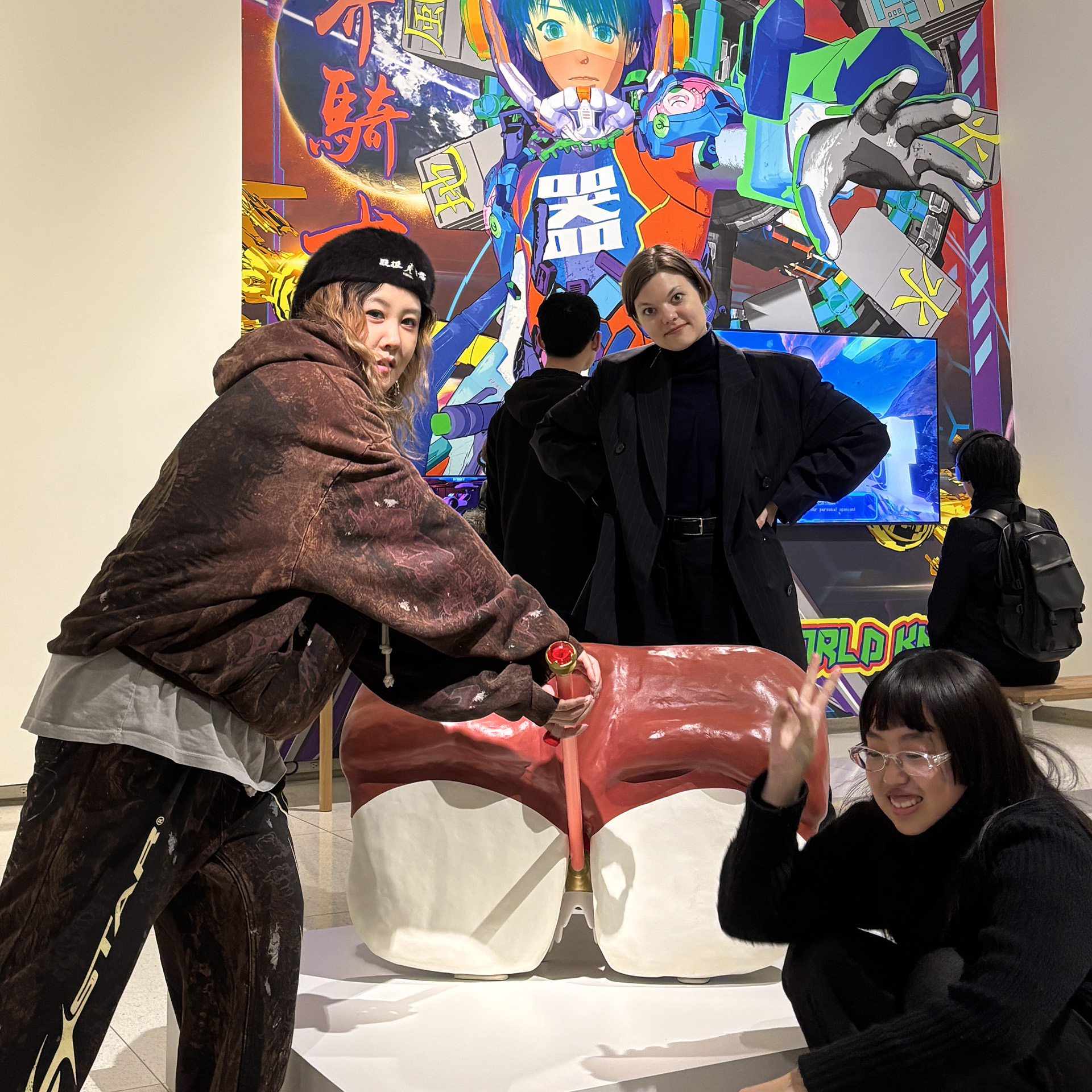
The following excerpt is from a conversation between Lu Yang and Dr. Ellen Larson, CAEA Associate Director, on April 1, 2026, at the Smart Museum of Art.
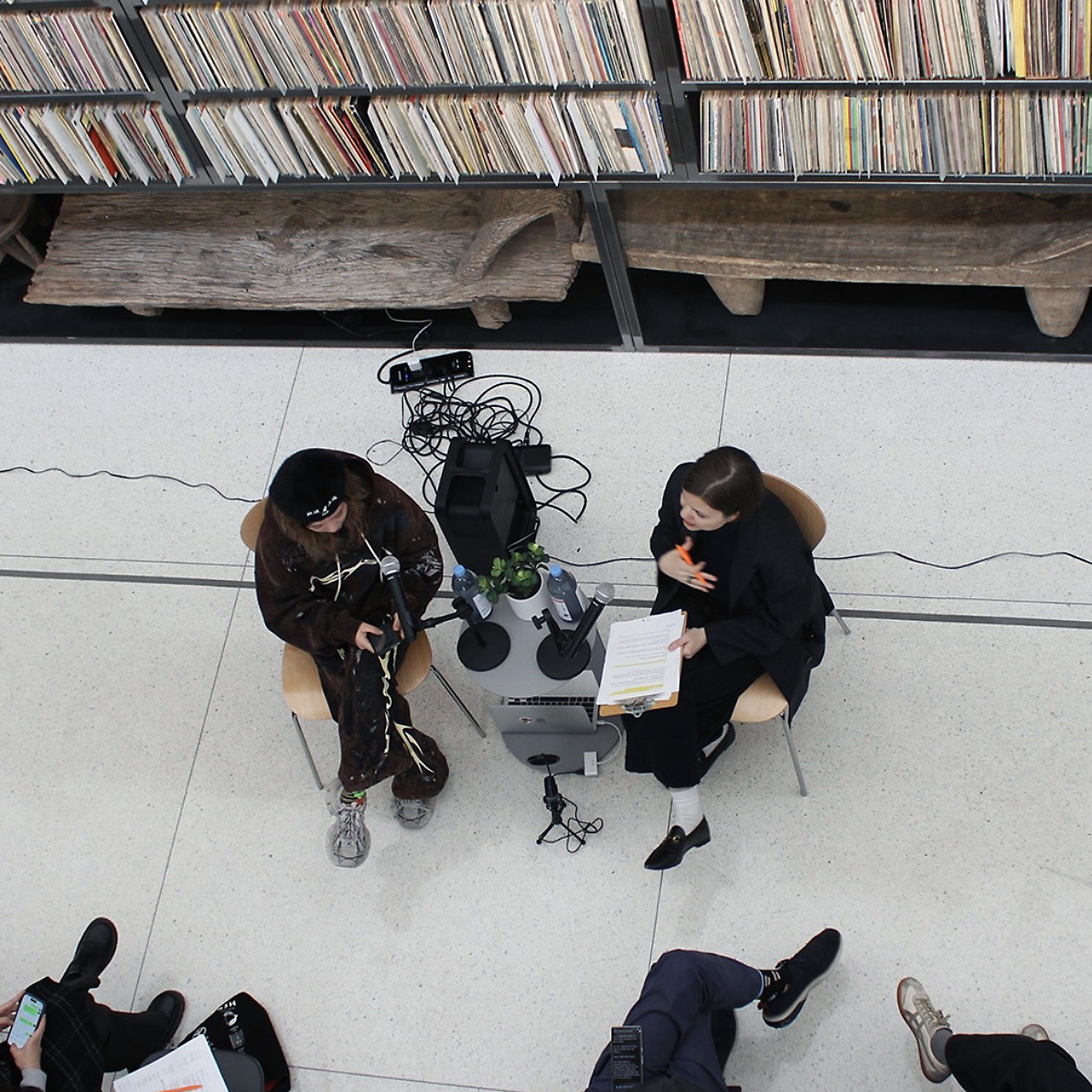
Ellen Larson: I'd like to begin with discussion of your practice more broadly. Your work often it feels like we're entering this fully constructed universe that's populated by digital avatars, Buddhist cosmologies, and immersive environments. So, my question for you is how do you think about world-making as an artistic method? What does world-making mean to you?
Lu Yang: For me, it’s not about creating a completely new world from nothing. In most forms of world-making—especially in industry—it often begins with projection; with ideas and concepts we already have. We build from what exists rather than inventing in isolation. In that sense, world-building is a way of projecting our mental concepts into a virtual environment. But it’s not entirely separate from reality—it remains closely connected to how we already understand and experience the world.
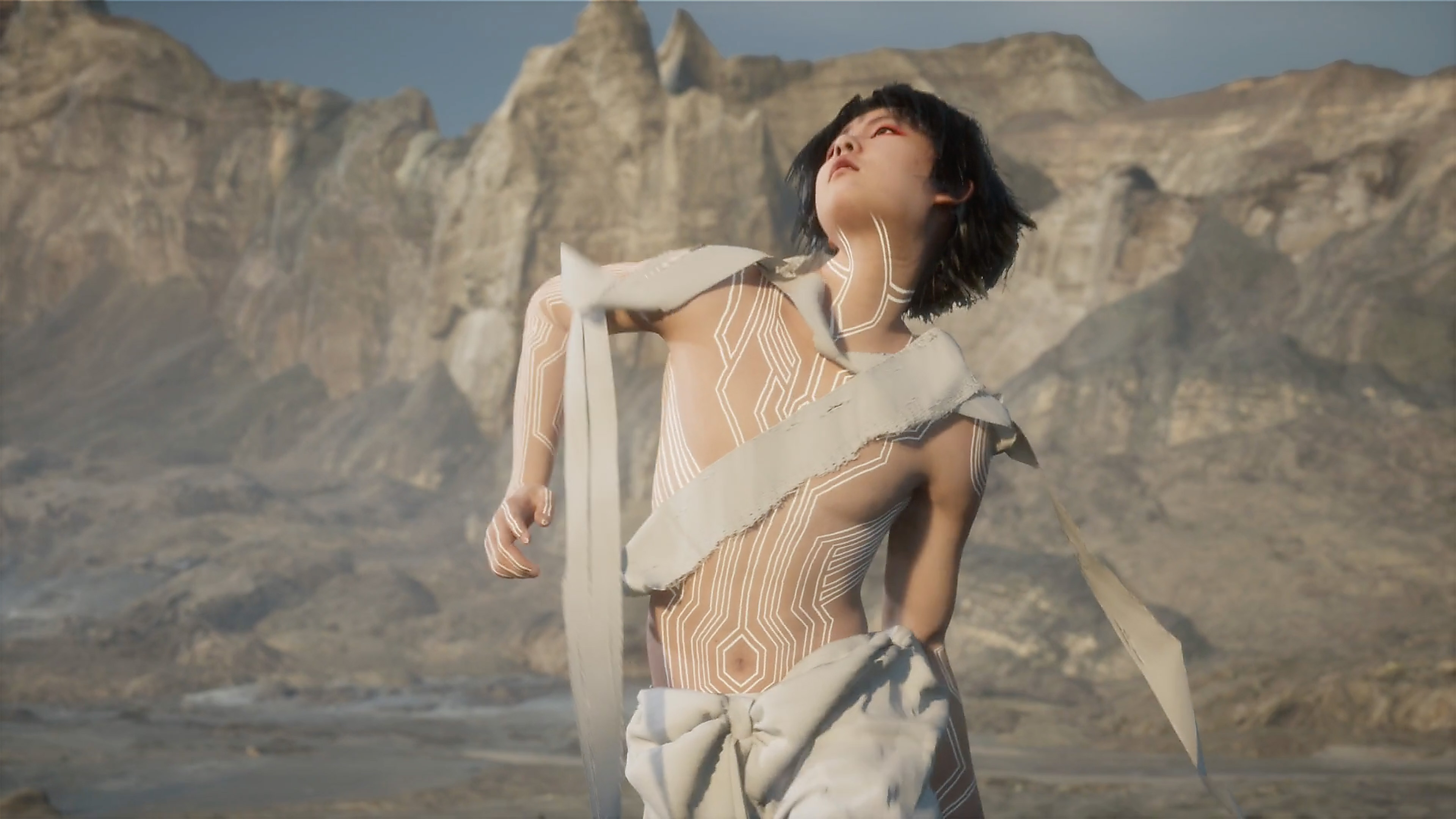
Ellen Larson: Building on your ideas about the self in relation to these worlds, I’m reminded of your 2015 work Delusional Mandala. For those who may not be familiar, the video begins with a transformation process—what appears to be a real, physical person being scanned and translated into a virtual avatar using 3D technologies. I’d love to hear more about that figure: is it you, or a kind of constructed or fictional character? The avatar, which uses your own facial features, seems to appear and reappear throughout your work. I’m curious how you think about this kind of bodily transformation. How does the avatar function for you? Is it a vessel, an illusion, or something else entirely? Could it be understood as a form of rebirth within digital space? How do you conceptualize this transformation?
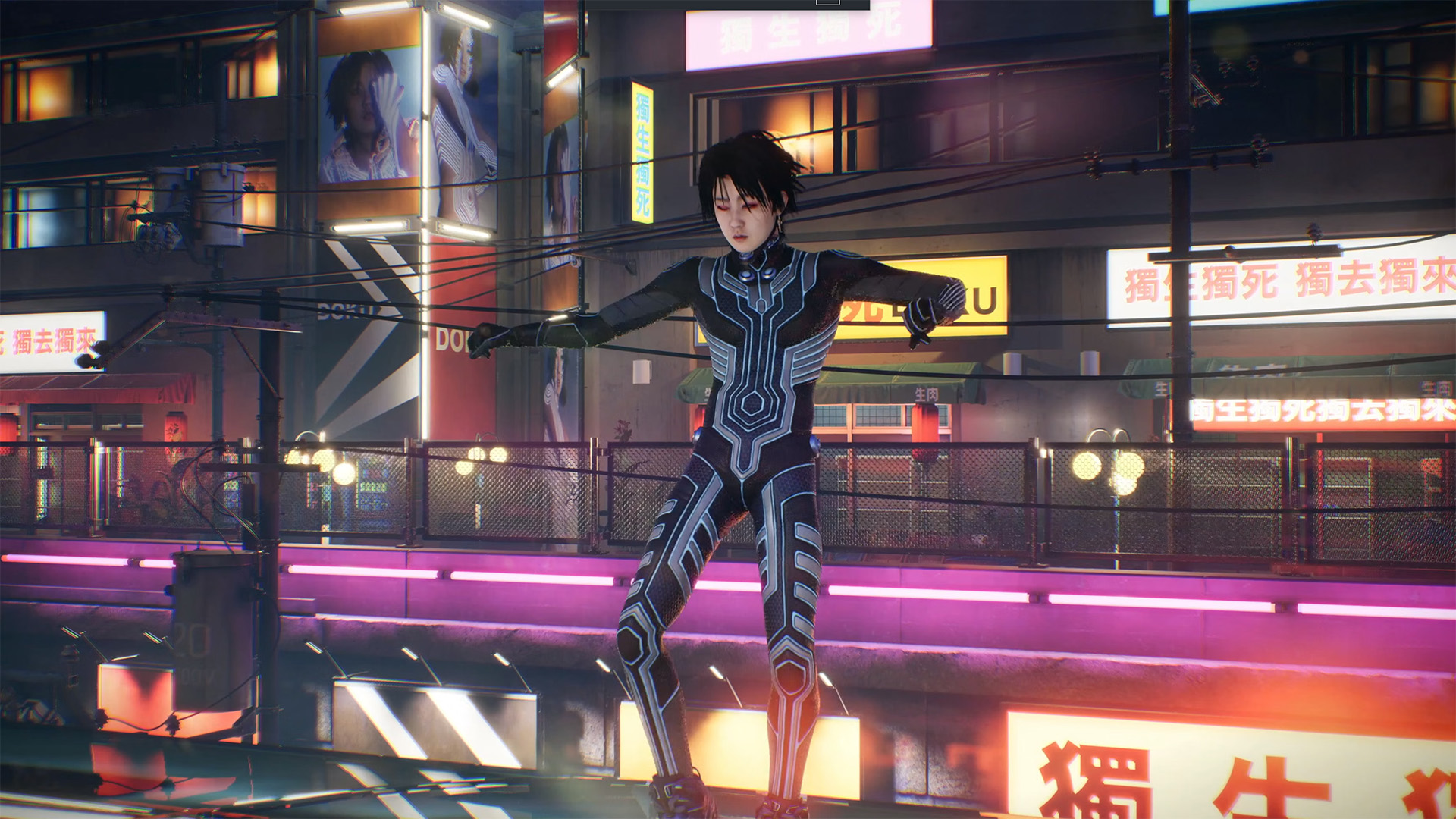
Lu Yang: The work you mentioned, Delusional Mandala, which I made about ten years ago, was the first time I used my own face as an avatar. For me, this was a very useful form of practice. In that work, I explore a number of taboo subjects—such as how we confront disease and death—as well as themes related to the limbic system and human emotion. In Buddhism, there are meditative practices that involve imagining the body in specific ways. For example, there is a concept of reflecting on the body as composed of thirty-six impure elements. The body, as a vessel, is understood through these components as part of a process of contemplation and detachment. In this work, I imagine encountering different forms of death and various possibilities of illness. So. the process of making it is not simply about producing an object—it is itself a kind of practice. After this project, I continued to develop other kinds of avatars. Then, in 2020, I decided to create a more realistic avatar based on my own face using a game engine. The work presented here, Material World Knight, can be understood as a culmination of this ten-year period of practice.
Ellen Larson: My understanding is that around 2019–2020, you developed Material World Knight, which is included in the exhibition, as a kind of culmination—or even retrospective—of your work over the past decade. Could you talk about that process? How did your practice evolve from Delusional Mandala to Material World Knight and then to Doku?
Lu Yang: During the time I made Delusional Mandala, around 2015, CGI technology was not as advanced as it is today. Now, with tools like MetaHuman in Unreal Engine, the level of realism is extremely high—it becomes difficult to distinguish what is real from what is virtual. But in 2015, you could still clearly see that the avatar was a 3D model.
In Material World Knight, Delusional Mandala actually appears as one of the levels within the game. The game incorporates many of my earlier works, so in a way, it becomes a reconstruction—or integration—of my past practice. Doku represents something new that emerged from this process. I still remember how I felt while making Delusional Mandala—it was very much a form of practice, especially in the way I was building these layered virtual worlds. Over time, this process has come to feel like projecting oneself into a virtual space. It’s almost like looking into a mirror—but at the same time, you are gradually letting go of your fixed identity within that virtual world.
Ellen Larson: Thinking about the relationship between the physical and virtual worlds—and the way you describe gradually abandoning identity within virtual space—brings me to your work in this exhibition within the context of Beyond Boundaries. As you know, this exhibition reflects on a history of projects at the University of Chicago, particularly those spearheaded by Wu Hung. It builds on earlier exhibitions such as The Allure of Matter, which explored how artists use materials to generate meaning—and even proposed that material itself can be meaning.
In The Great Adventure of Material World, we follow an androgynous protagonist through cycles of conflict, transformation, and renewal, drawing on the Buddhist concept of Samsara—a continuous cycle of birth, life, and death. So, I’d like to ask a broader question: in your practice, what does “material” mean? When working with digital media—where the boundaries between the real and the virtual are constantly shifting—how do you understand materiality? What, for you, constitutes “the material world”?
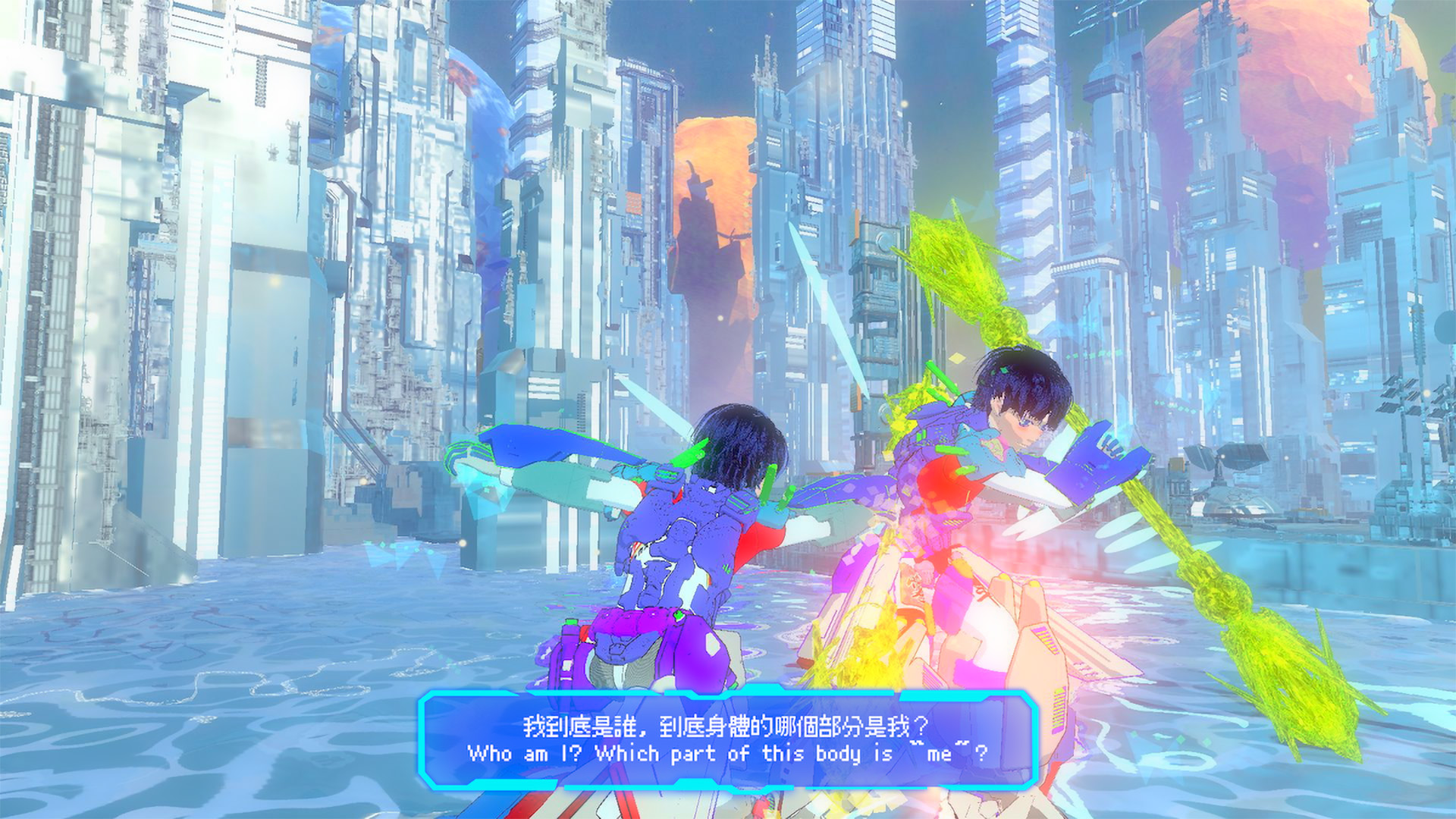
Lu Yang: I think materials carry a great deal of meaning. In [The Great Adventure of] Material World, the title itself comes from a Buddhist idea: the “material world” refers to our vessel—the container in which we exist. For example, this museum is a material space, situated on land, which is itself part of the earth. These are all layers of materiality—materials within materials.
In my practice, I work primarily with virtual materials. Within a game engine, these materials offer far more possibilities and freedom. You can construct them, combine them, and even redefine their physical properties in ways that wouldn’t be possible in the real world. I’ve found that working with physical materials is not my strength—whether in sourcing them or collaborating with fabricators. So, I’ve chosen a different path. For me, virtual materials provide a space of greater flexibility and creative freedom, allowing me to build the kinds of worlds I’m interested in.
Ellen Larson: So in a similar vein, thinking about these relationships between physical material containers, virtual containers, and maybe even the quest for freedom, I'm curious how we might be able to bring gender into the conversation—do we see shifting gender or shifting identities between human and non-human states? Are you thinking about gender in relationship to practice?
Lu Yang: For me, gender doesn’t function in the same way when I’m creating. But once I leave the studio and enter society—when my physical body is perceived by others—people often become very focused on gender. In the process of making work, though, I don’t think about it at all. I don’t have a point of reference or comparison. I’m usually working alone, and when I’m deeply immersed, I’m not even aware of my own body—I don’t look in a mirror, I simply forget it. In that sense, creating feels like entering a state where those external frameworks fall away. It becomes a process without fixed reference points, where identity—especially something like gender—no longer defines how I think or make. Actually, it's more like, how do you say, 无我?
Ellen Larson: like “non-self?”
Lu Yang: Yeah. Non-self. You can't. I just don't think about those kinds of things. And for my works, all my characters, they don't have any identity. They don't have any gender. They are just what I want to create those kinds of characters, like what I'm making the ideas by myself. And I think for all creators, they come to this world, and they can't choose their gender. They can't choose where they're born and they have to carry all those backgrounds just because they’re born at that kind of status.
Ellen Larson: I think this also brings in another consideration—you're thinking about these digital avatars as an extension of the body. I'm also curious how Buddhism intersects with digital technologies in your practice. Where does your engagement or your interest in Buddhism come from? And how does it shape the work? Maybe also in relationship to the things that we're talking about in terms of identities or amorphous identities?
Lu Yang: I think Buddhist philosophy, for me, is a tool that can really help you improve the world. Whatever you face, Buddha has already told you what the situation is, and you can find the results to work through it. Buddhism is a very useful wisdom for me. And if I'm working with these kinds of ideas, it's a way of practice I can do. And also, if I hide these kinds of ideas in the work, maybe I can plant some seeds, sharing with the audience.
Ellen Larson: So, setting this up to think more about Buddhism in the context of reactivating Buddhist cosmologies or images—one of the projects we work on at the Center for the Art of East Asia is called the Dispersed Chinese Art Digitization Project. The project is interested in reactivating fragmented cultural heritage through digital reconstruction. We're also using 3D scanning tools and creating immersive environments aimed at reconnecting objects, sites, and histories that have been physically dispersed across time. So, I'm curious how you think about the relationships between these two kinds of reactivations within your own practice?
Lu Yang: When thinking about the 3D scanning of old Buddhist statues, I see it as a new kind of archive for historical objects—something especially valuable for this moment. I actually did something similar in my Doku series, where I worked to archive traditional Indonesian dances. I brought a team to Bali, where there are highly complex forms such as Balinese dance and warrior dance. These performances require incredibly precise control, from subtle eye movements to the smallest gestures of the fingers—it’s extraordinary. Many dancers begin training at the age of five and devote their entire lives to mastering these forms, which have been practiced for thousands of years. I used motion capture technology to archive these movements. The avatar does not need years of training; I can simply apply the data, and it moves like the dancer. For me, this is a new way of preserving very old traditions.
Ellen Larson: So maybe switching gears back to the broader context of the exhibition—I’d like to think with you about how Beyond Boundaries reflects on ways in which contemporary Chinese art has been shaped through global circulation, exhibitions, institutions, and other forms of exchange. I'm really curious how you think about your work in relationship to this term, "contemporary Chinese art." Is it a meaningful category to you at all? And within the context of this exhibition, what does it mean for you to be included in an exhibition that is looking back over the past three decades of contemporary Chinese art research and curatorial work?
Lu Yang: The only label I really place on myself is that I am Chinese and that I was born in Shanghai. I read many Buddhist texts in Chinese, and I naturally grew up within that cultural and intellectual environment—this is my relationship to China. But when I make work, I never consciously think about those categories. My work is centered on things like Buddhist wisdom, the body, illusion, death, technology, and samsara. These are not only Chinese concerns—they are human concerns. I want to expand these ideas beyond China and connect with a wider audience. I don’t want viewers to need extensive cultural background to understand the work. What matters to me is that all human beings can enter into it, because the questions I am addressing—the problems we face and the things we need to think about—belong to everyone.
Ellen Larson: That also reminds me of the conversation we had last night with UChicago neuroscientist Leslie Kay. She wasn't familiar with your work beforehand, but after spending a little time with it, she realized how many connections there were between what she does and what you do. So, I think that is really productive—to focus on the topics and the ideas and not necessarily get encumbered with cultural specificity.
Lu Yang: I think with Buddhist philosophy—I don't actually divide wisdom into ancient and modern—as if we have to stand before something old in a spirit of confrontation. Let's zoom out on history, earth, in this universe—human history is just a little spot. Why do we divide it in such a complex way? I always think that whatever can help us understand the world, we can just look into it, and we don’t need to divide it too much—what is old, what is young…
Ellen Larson: Building on that—thinking about this presentation in the context of the Smart—what are you hoping audiences take away from encountering your work for the first time?
Lu Yang: I’m actually not looking for any particular audience response. There is a Buddhist idea that I deeply agree with: in Chinese, it is “因上努力,果上随缘.” It means that you devote yourself fully to the cause, but you let go of attachment to the outcome. For example, I might spend a year making a work—isolating myself in the studio, not going out, giving all of my time and energy to the process. But once the work is finished, I do not fixate on the result. I cannot expect too much from what happens afterward. It is the same with the audience’s response. I believe everyone will have their own understanding and interpretation, and that is not something I can control, nor is it something that belongs to me.
Ellen Larson: Yeah. Well, I think on that note, that's a great way to open the conversation to folks in audience who have joined us this evening. Does anyone have a question or would like to share their thoughts with Lu Yang?
Audience Member 1: Hi, I'm also an artist and video game producer. I have two questions. First, I'm very curious about your process of game-making—specifically referring to the work in the show. Do you create stages, or start with ideas, or with asset builds first? And my second question is: how do you deal with isolation while sitting in front of the computer building things for a month at a time? I think that's a very common position for visual artists.
Lu Yang: I think a month is too short—if you really need to complete a work, you need at least one year or several years, spending fourteen to sixteen hours a day every day. This is how you have to spend your time.
Audience Member 1: And the process of starting a project, taking that time, and seeing it through to completion—how does the project develop? And in relation to the isolation, do you talk with people? How often, and how does that factor into the building process?
Lu Yang: I feel that I am always in a very intense working mode—it is almost like being a monk. Recently, I’ve realized that even when I’m talking with people, part of my mind is still focused on the work, making sure everything will eventually come together in a meaningful way. There is always this sense that something remains unfinished, that I need to keep working. To make art, you have to give your life to it. You spend your time, your energy, your money—everything. The process of making a work begins with excitement. At first, when you create something, you can imagine anything, and that feeling is very powerful. But that excitement only lasts for a short time. After that comes responsibility—you have to commit, and you have to pay for it, in every sense. What follows is long periods of isolation, discipline, and very hard work. So, creation is not only inspiration; it is also the willingness to sacrifice and endure for the work.
Ellen Larson: How long did you spend working on the piece in the exhibition?
Lu Yang: One year. And I think that's already quite short.
Audience Member 1: I'm also an artist and I use video games as a medium in my art practice. I'm curious how you think the medium affects your language, in terms of creation, because I've seen a lot of your work before and it includes a lot of film, video, sculpture, and installation as well. How do you think about that—as an artistic approach?
Lu Yang: You mean the installation in my works?
Audience Member 1: Yeah.
Lu Yang: Yes. In recent years, I always have a main work—a video or video game—and I create an environment around it. Is that the environment you're talking about?
Audience Member 1: Yeah, I am thinking about your exhibition at Amant Gallery in New York.
Lu Yang: Oh, thank you. For me recently, I’m always doing something like that but actually what it means for me is decoration. I need to create atmosphere, so people can have a more immersive feeling inside it. People today watch so many intense things that their dopamine response doesn't work the same way. So you need to create something that makes them feel comfortable and want to stay in the space.
Audience Member 1: Interesting. I have a second question. I wonder is meditation part of your inspiration?
Lu Yang: I don't know if what I do is meditation exactly, but in recent years I've always gone to cliffs. I love to sit on the cliffs for maybe an hour or two. Everything will come to your mind, from the universe. And you can take all your ideas from inside your mind.
Audience Member 2: This is kind of related to the previous question but less temporal. You talk about working like a monk—but monks live together in temples, with other monks. Do you consider that you have people around you working with a similar ambition?
Lu Yang: When I say I work like a monk, I mean like a monk in retreat. But even monks are not alone—I also have a small team. What I realized while working with them is that I sometimes couldn’t understand why they worked such short hours. Then I understood that the problem was mine: they are working for me, not for their own work. I had to adjust my thinking. They are not monks, and they probably think I’m crazy. When they come to work with me, they expect an artist who is maybe a little well-known, someone they can learn from. But what they discover is that I’m like a monster. If they work ten hours a day, they see that I can work sixteen or even eighteen hours without stopping. They think I’m completely unreasonable. I keep thinking, how can you only work eight hours a day? But then I remind myself—if I were working for someone else, maybe I could only work two hours a day.
Audience Member 3: Hi, I'm very curious about how you collaborate with the people who wrote the scripts. As you mentioned, people today have very short attention spans, so your animation is very eye-catching—I could sit and watch it for a long time. But I also noticed that the writing and narratives are very philosophical and deep. I recall that some of the writing in Doku involved a collaborator? I'm curious how you communicate your ideas with writers, and how you integrate Buddhist philosophy into modern pop culture like gaming and animation.
Lu Yang: I actually write most of it myself—I don't have a writing collaborator. What you're sensing as deep philosophical content isn't only from me, because I'm a practitioner. I read the books; my daily thinking draws on a lot of ideas from Buddhist wisdom. So yes, many ideas come from Buddhism, not from me. But the text is written by me.
Audience Member 4: So how do you translate those philosophical ideas into animation characters? I saw Balinese dance in Doku—is that right?
Lu Yang: Yeah.
Audience Member 4: So how do you connect the narrative to the visuals?
Lu Yang: For the Balinese dance project, I did a great deal of research because I had read a book in which the author described Balinese dance as one of the purest forms of bodily discipline. That idea stayed with me. I began to think of it almost as a way of training the body into a robot, because Balinese dancers can control every detail of movement—the angle of the ankle, the movement of the eyes, the gestures of the fingers, even the rhythm down to beats per second. In a way, that precision resembles how a robot moves. So I started to think of it as a kind of reverse training: not making robots more human but training the human body to function like a robot. In the Doku series, I was thinking a great deal about the body and the ways we discipline or train ourselves into mechanical systems. This also connects to my earlier work, where I researched Parkinson’s disease. Parkinson’s patients experience tremors because of disruptions in the deep brain—they cannot produce enough of certain neurological signals. When I spoke with doctors, they explained that each patient’s tremor has a different frequency. During that period, I created works such as Parkinson’s Disease Orchestra, where patients with different tremor frequencies could collectively form an orchestra.
For me, all of these works are connected. It is never a matter of finishing one project and moving on to something separate. Everything exists within the same conceptual world in my mind.
Ellen Larson: Maybe one more question.
Audience Member 5: Thank you for the great discussion. I just have one question. I wonder if the use of what we usually call AI technology in your work generates new possibilities—formally or conceptually—or whether it creates new kinds of problems?
Lu Yang: We were talking about this yesterday—CGI work is incredibly demanding because it requires an enormous amount of repetitive, meticulous labor. Behind every CGI animation, there are countless hours of work from many people. Even for me, to achieve that level of precision and complexity, you have to dedicate your life to it. I have always imagined a situation where, if I have an idea, I could immediately realize it visually. I think AI is getting very close to making that possible. I first started experimenting with AI around 2021, but at that time it still wasn’t capable of producing what I needed. I kept testing its possibilities, and for me, 2024 became the turning point—the moment when AI became strong enough to generate the kind of work I had been imagining.
Ellen Larson: Great. Well, once again, thank you so much for joining us for this wonderful conversation.
Lu Yang: Thank you.