Freedom in Limitations – Ouyang Zhenyu
Ouyang Zhenyu is an Associate Professor and master’s supervisor in the Department of Art at the School of Humanities and Social Sciences, Xi’an Jiaotong University. From 2019 to June 2026, he also led subprojects of the Dispersed Chinese Art Digitization Project. His research focuses on sculpture and traditional Chinese sculptural art. In recent years, he has concentrated on sculptural practice as well as the digital reconstruction, presentation, and dissemination of dispersed Chinese cultural heritage.
Greg: You began working primarily in relief sculpture but have been focusing more recently on linocut printing—what led you in that direction?
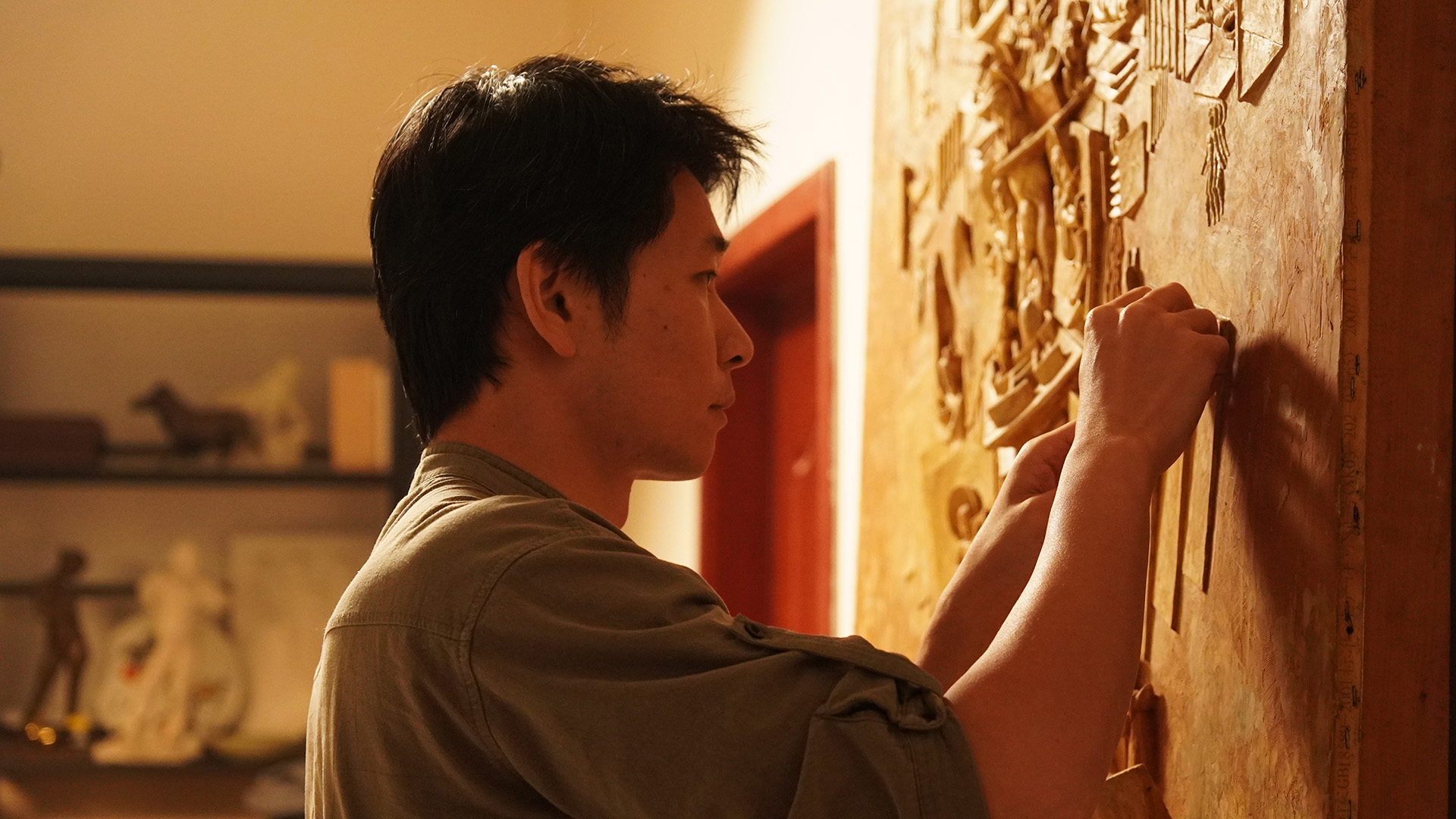
Ouyang: The problem with sculpture is that it takes an enormous amount of time to realize one idea. I constantly have ideas popping into my head and found printmaking allowed me to express an idea much more quickly. The time cost, and trial-and-error cost, are both much lower—I can go from an idea to carving it, printing it, and then evaluating it all in a short span of time, and I can repeat it over and over—going through the complete creative cycle again and again. Speeding up that process has greatly improved my understanding of art and my ability to express through visual language.
Greg: Can you talk a bit about the process that led to your Cubic Koan series?
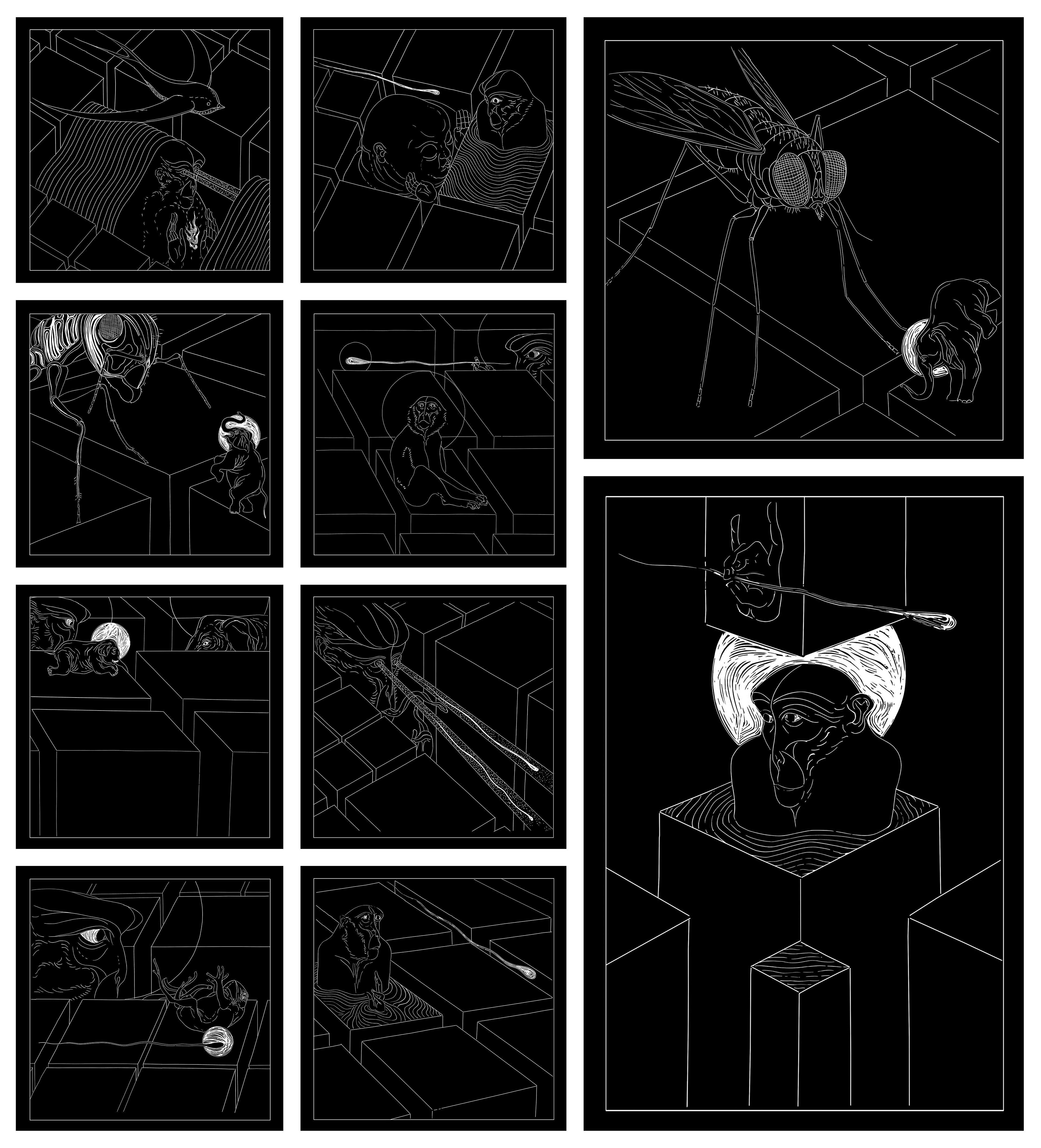
Ouyang: At first, I just wanted to do an exercise with my students. I suggested that each person pick one element and then stick with that same subject and format for the entire semester. The goal was to see if they could produce 20 to 30 works using the same subject and same visual language.
When we’re creating, we unknowingly rely on old visual experiences—imitating or borrowing from what we’ve already seen before. So I wanted to run an experiment: imagine I give you a simple object, like a cup, and ask you to make 100 versions of it. By the time you reach the 10th or 15th one, all your familiar visual habits will be exhausted. At that point, you’re forced to face a real question—can you actually create something new, beyond imitation?
I wanted my students to experience that moment. And honestly, it was also a great exercise for myself, because I had never done that kind of disciplined practice either. By the time I got to the fifth or tenth piece, it became incredibly difficult. But then gradually, eventually, I made a small breakthrough—I managed to find variation within strict repetition. That feeling was exciting. It made me feel like I was slowly touching the edge of something deeper—like I was starting to confront my true core theme.
Looking back, I realized I’m particularly drawn to philosophical reflection and to the concept of space. That’s why in all these works you’ll see the figure of a monkey—it started as just part of the exercise, but gradually it grew into the image I had in my mind. The monkey became a tool for expression.
Greg: Can you elaborate on what the monkey in this series represents for you?
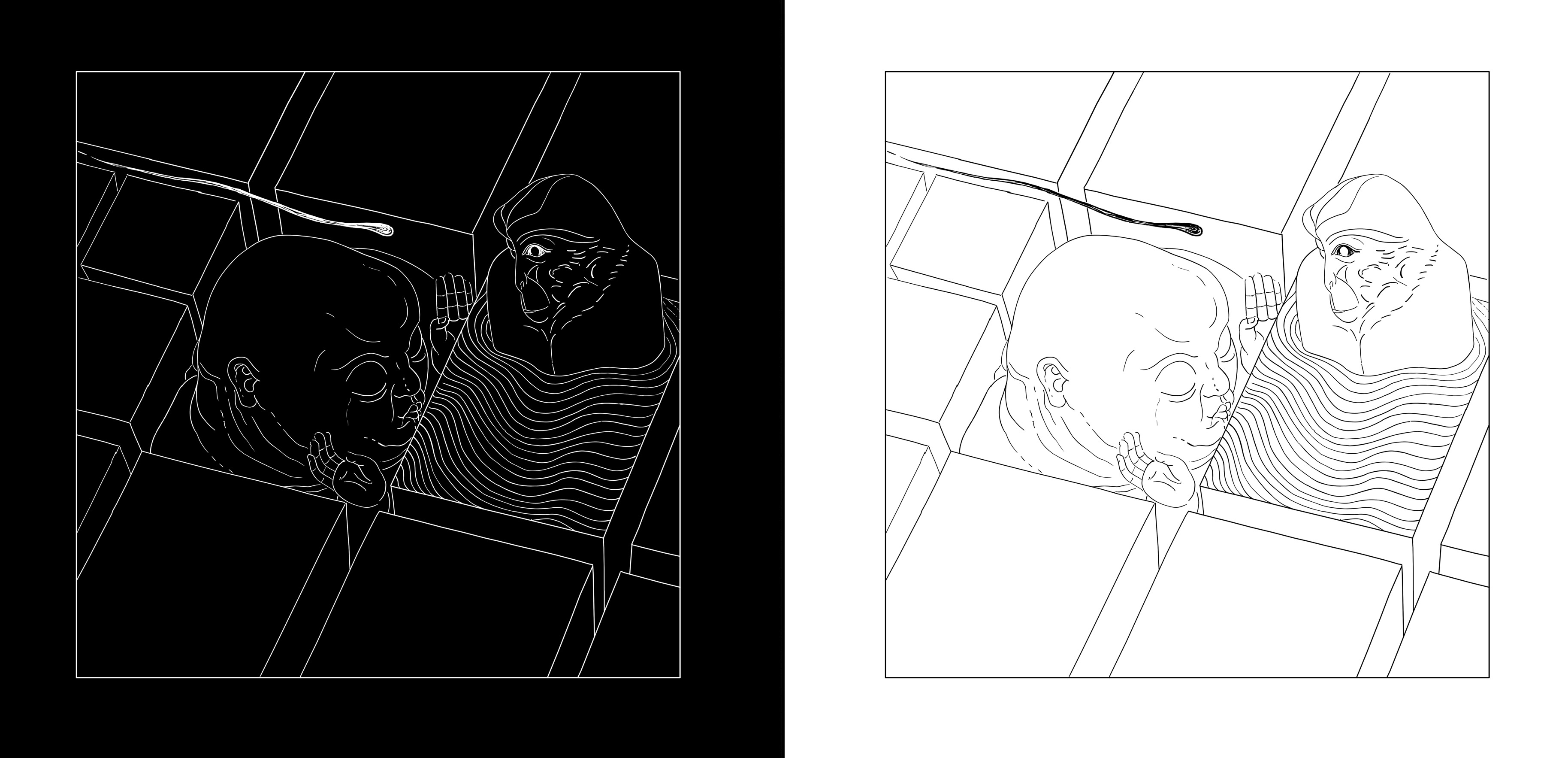
Ouyang: It actually comes from Buddhist ideas. In that context, the monkey is used as an icon—it represents the “small self,” or what in Chinese is called xin zei (心贼), which literally means “the thief of the mind”—the wandering thoughts of the unsettled psyche that clings to things and gets in the way of deeper awareness, here imprisoned within precise three-dimensional grids. Each print becomes a variation on the same proposition: When the cube serves as a cage for thought, does the constrained delusion paradoxically reveal a more fundamental freedom through repetition? The adherence to fixed form mirrors the Zen practice of huatou—repeating an unsolvable question until the cracks of awakening appear. The series originates from a self-imposed creative paradox: When artistic expression is reduced to an absolutely rigid form—a singular monkey motif and repetitive cubic structures—how might creativity manifest? In Buddhist tradition, the koan disrupts habitual thinking through unanswerable queries; here, the geometric rigidity of order and the restless nature of the delusive mind together construct a visual contemporary koan.
Discovering a theme is really the most important thing for me. Once I have that core theme, all kinds of new inspiration or stimulation then naturally connect back to it.
The two motifs—the monkey and the cubic space—are merely elementary symbols. If there is some kind of overall system to my artistic expression, it must evolve from these elementary symbols. Once a symbol is established and forms a corresponding bond of conceptual expression or visual carrier with the creator, it will undergo self-organizing evolution in the creator’s inner mind.
My monkey figures bear a resemblance to luohans (arhats), but I didn't deliberately design them that way. They emerged as a self-organized manifestation of inner visual experience—something I only realized afterward. This latent self-organizing logic then materializes into tangible experience. Hence, my adoption of the monkey motif and its formal features are the spontaneous outflow of holistic personal experience through self-organization. In Chinese culture, we usually describe such a process with the concept of "internalization" (内化). This practice has allowed me to perceive how the mind operates, granting an experience bordering on holistic awareness. This insight led me to realize that the final visual outcome is not what matters most; what I find most valuable is the dimension of personal perception that the experience opens up.
It has thus gradually become clear that what I aim to present is not my personal vision, techniques, formal language, or any fixed artistic methodology. Instead, I seek to take art as a medium to experience the "wholeness of life".
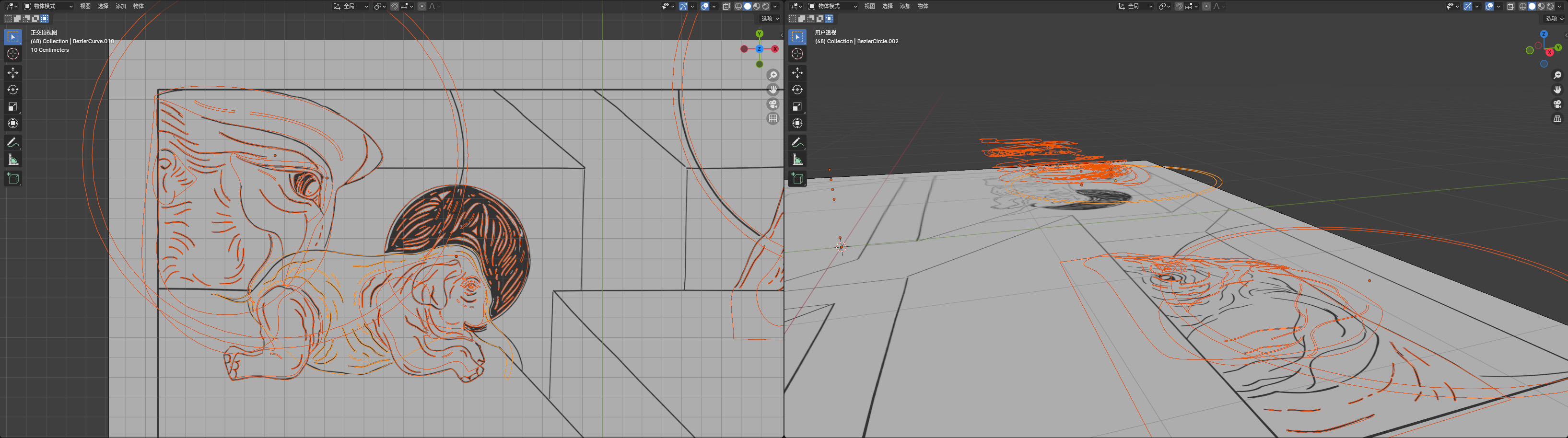
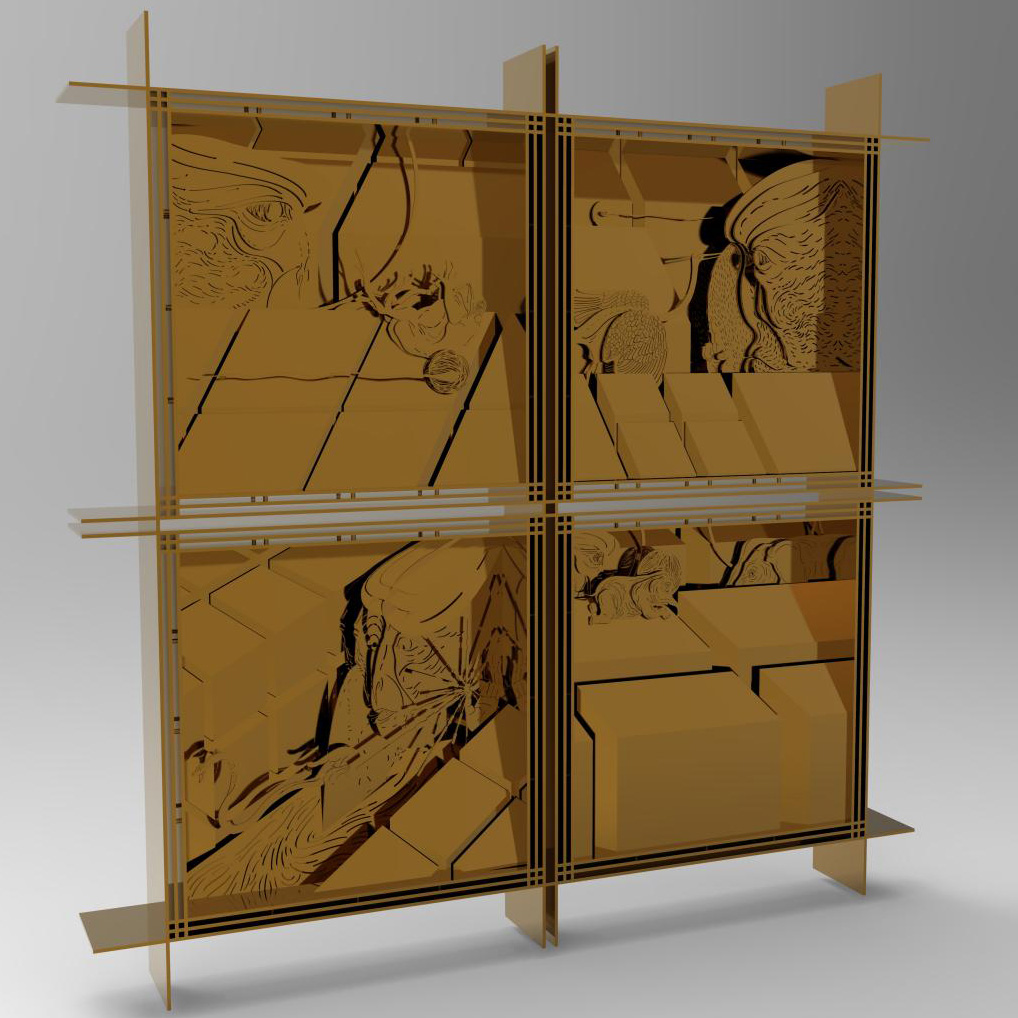
Greg: You’re working on expanding the series into 3d form. How does the meaning or experience of the images change when brought into three dimensions?
Ouyang: I’ve come to feel that ultimate answers dwell beyond logic. This series of prints aims to explore the boundaries of logic, and translating it into three-dimensional work is another extension of that. Elevating forms from a two-dimensional plane into three dimensions further unlocks the evolutionary potential of the symbols. It will also inevitably change the viewer’s perceptual experience—but I can’t predetermine what the audience will feel; what I anticipate more is the dynamic evolution inherent to creation itself.
Greg: I’ve been drawn to your Bardo reliefs each time I visit your studio. Can you talk about some ideas or feelings represented in those reliefs and perhaps how you came to them?
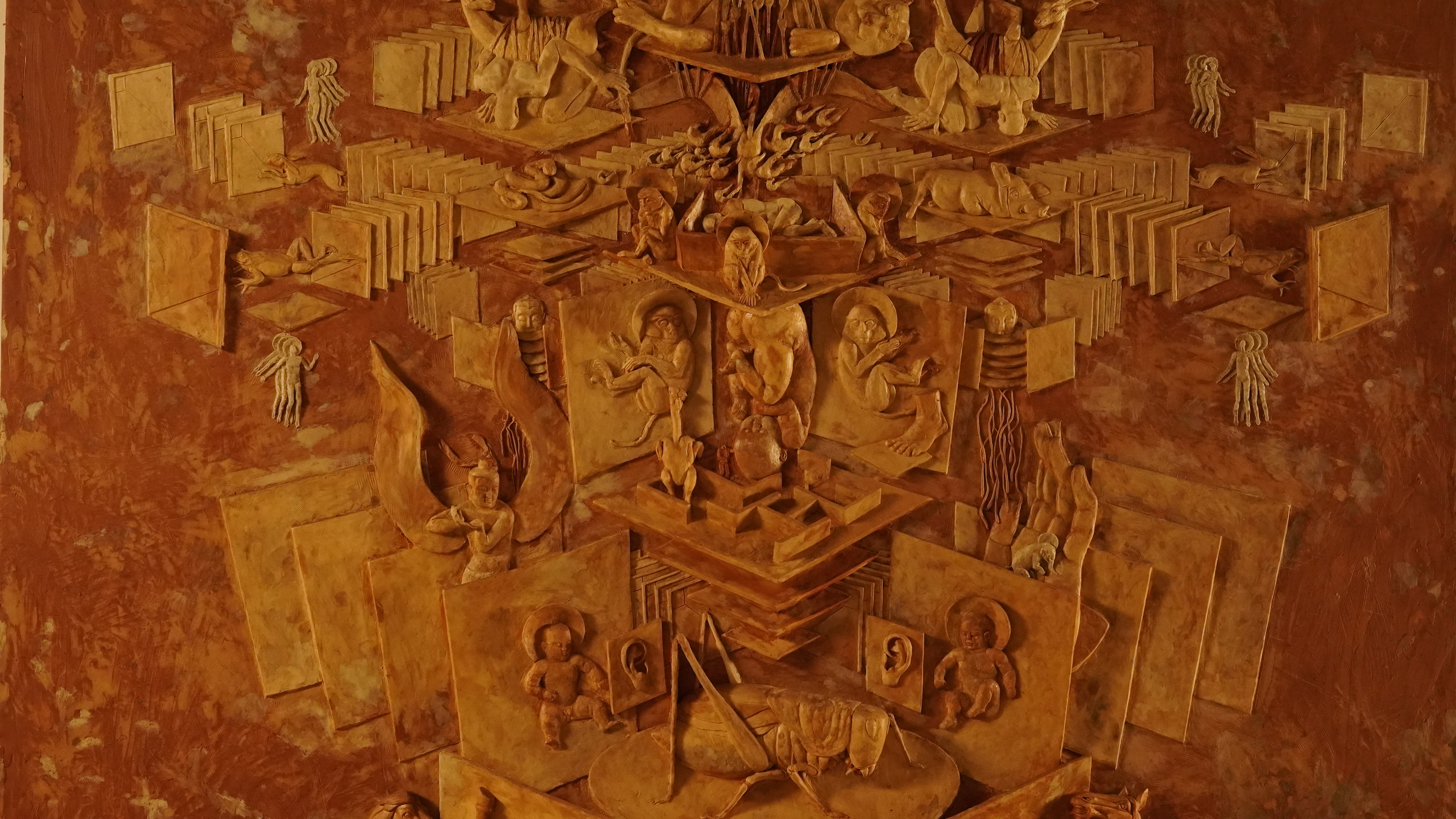
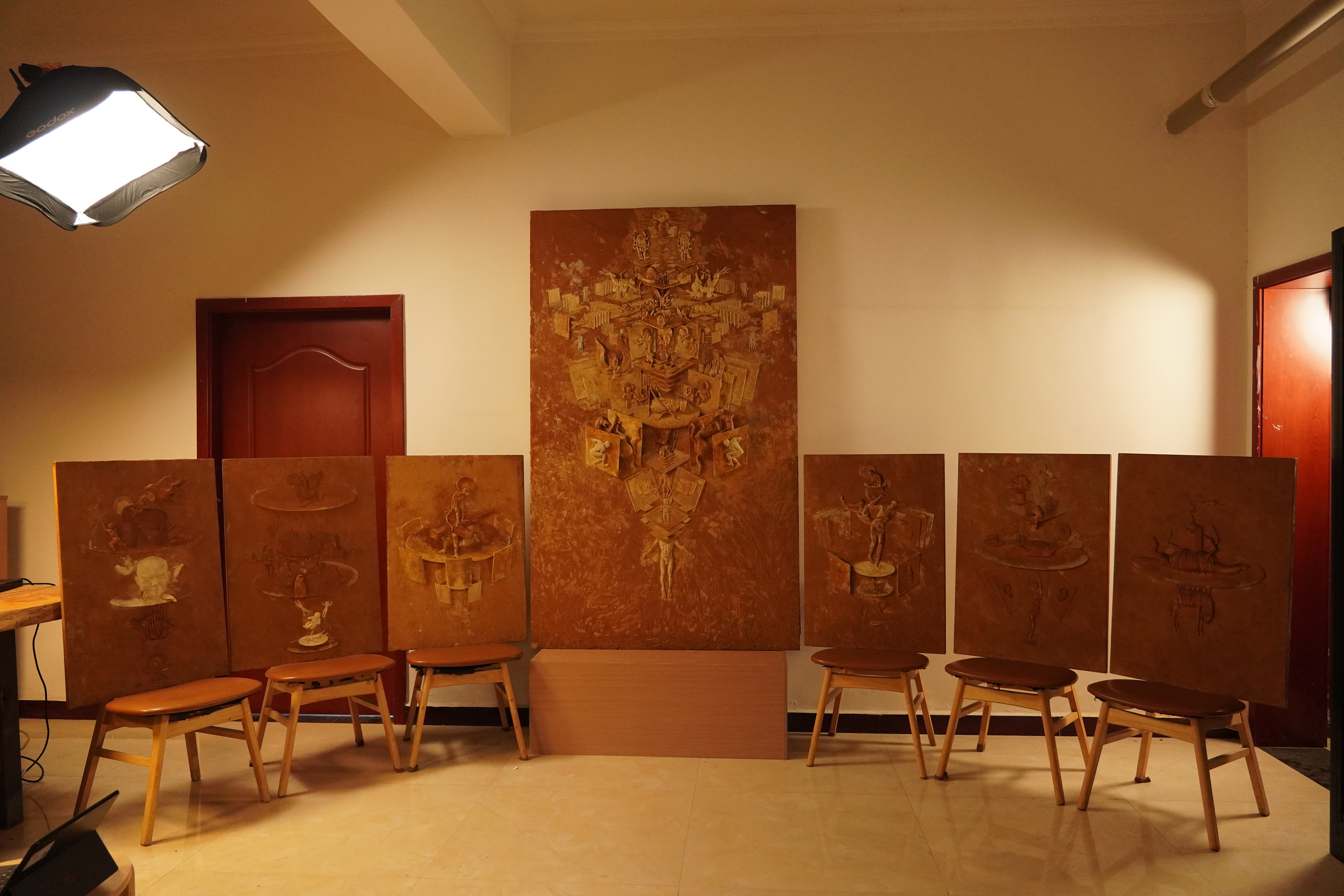
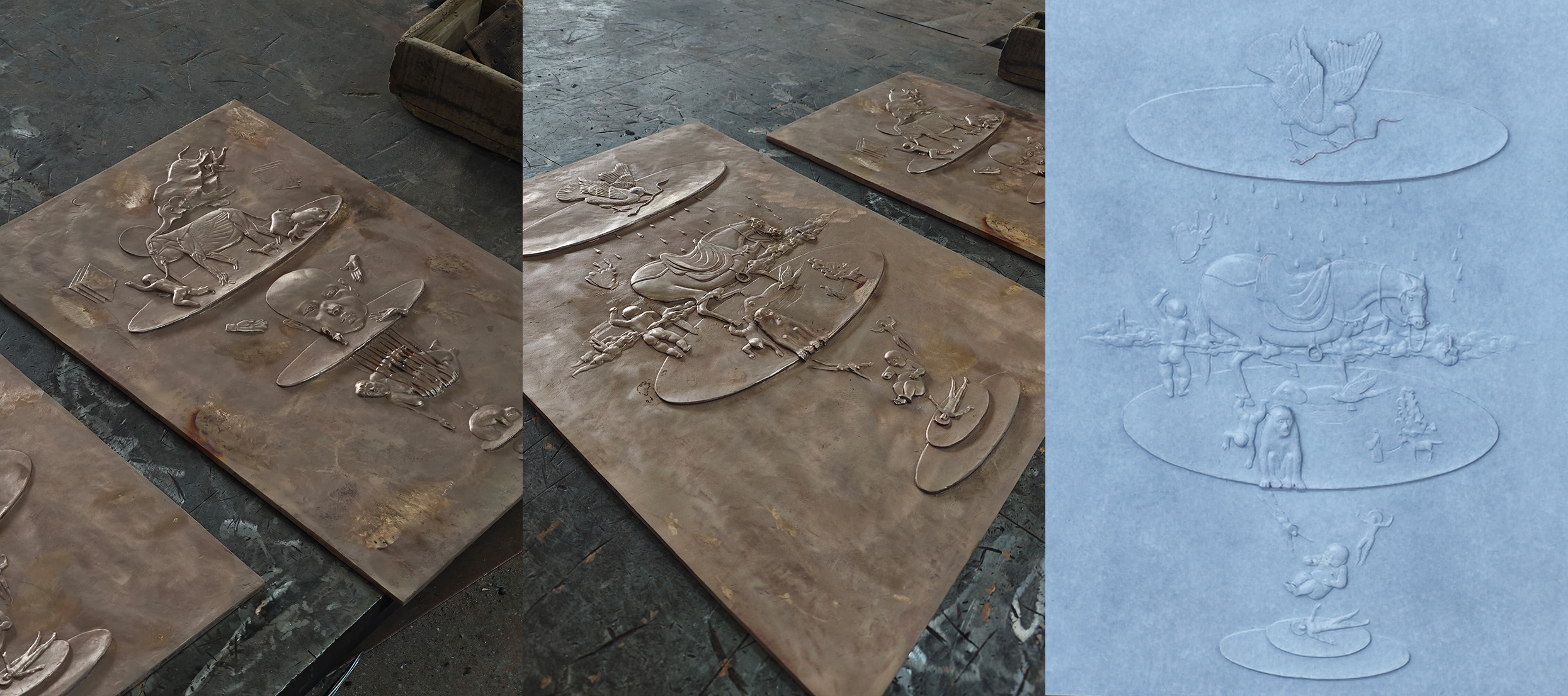
Ouyang: This work consists of seven panels — one large, more complex central piece, and six smaller ones around it. I plan to scan them and slightly reduce their size, mainly for cost reasons, because I’d like to eventually cast the whole thing in bronze.
The creative origin of this body of works is actually quite simple. I first encountered Buddhist philosophy and its worldview during my university years, and it brought me profound inspiration. In particular, its cosmology provided unique visual stimuli for artistic creation.
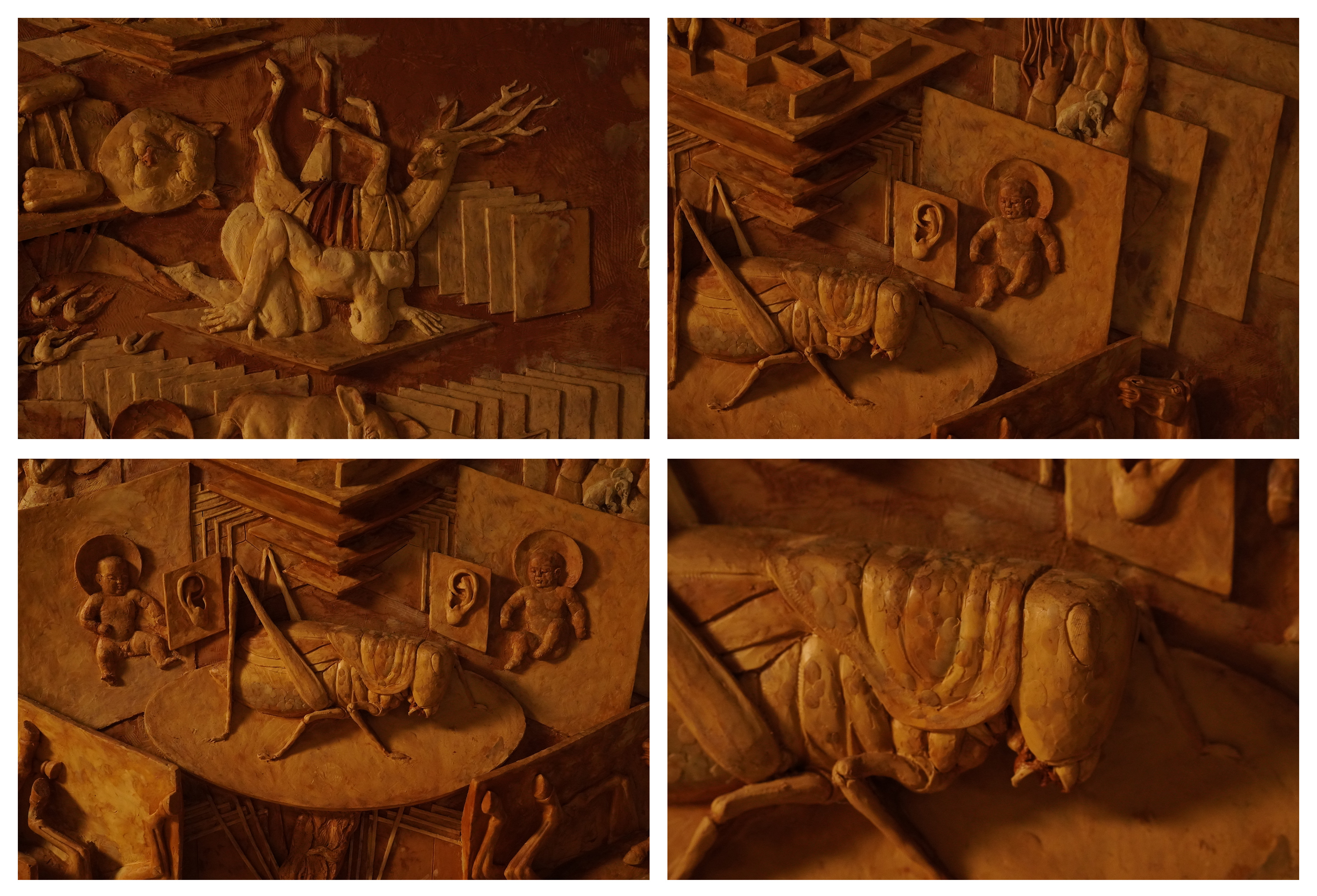
When I was a child, I killed several locusts in an act of mischievous impulse. Later, upon learning about Buddhist cosmology, I encountered the concept of saṃsāra—the Buddhist law of existence, the endless cycle of birth, death and rebirth for all living beings.
Driven by subconscious guilt, I repeatedly dreamed of locusts for a period of time. I then resolved to create a series of works centered on locusts as a sort of spiritual atonement. Looking back now, it seems rather naive, but it was this simple idea that led me to begin this series of relief works, and over a relatively long stretch of time it opened up a kind of free, introspective meditation on the core theme of life.
Greg: How do you see these in relation to your current linocut works?
Ouyang: The reliefs came earlier. I started that series back in my student days and continued it into my early career. Interestingly, that series is completely opposite in spirit to my printmaking work. When I was starting out, I was very interested in two things: Chinese Zen Buddhism and Surrealism in Western art history. I became interested in the unconscious and the stream of consciousness. I felt that my way of thinking at the time was quite close to that state, so naturally I ended up creating a lot of relief-based compositions.
I thought it was really fun, but ultimately I discovered that endlessly creating in this free, stream-of-consciousness way wasn’t very meaningful after a while. The experience itself was still valuable—it helped me understand myself better. But I wanted to end that completely free creative state and deliberately move into a state of total constraint—to experience it, to see what it would feel like, and see if these two approaches can help me understand myself better, and touch upon what true, fundamental creativity really is.
Greg: You had mentioned in the past that you were still working on the Bardo reliefs. What has prevented you from finishing them?
Ouyang: I kept getting stuck on the technical side, thinking there were still more details to refine, more to perfect. But my perspective has changed. I’ve come to realize that, compositionally and conceptually, the piece already expresses what I wanted it to. It’s complete in that sense. Maybe there are a few parts that aren’t as refined as I once imagined, but that’s okay. In China, we tend to emphasize technical precision—everything has to follow anatomy and structural accuracy—and while that’s valuable, I don’t think it should prevent an artist from deciding a work is done.
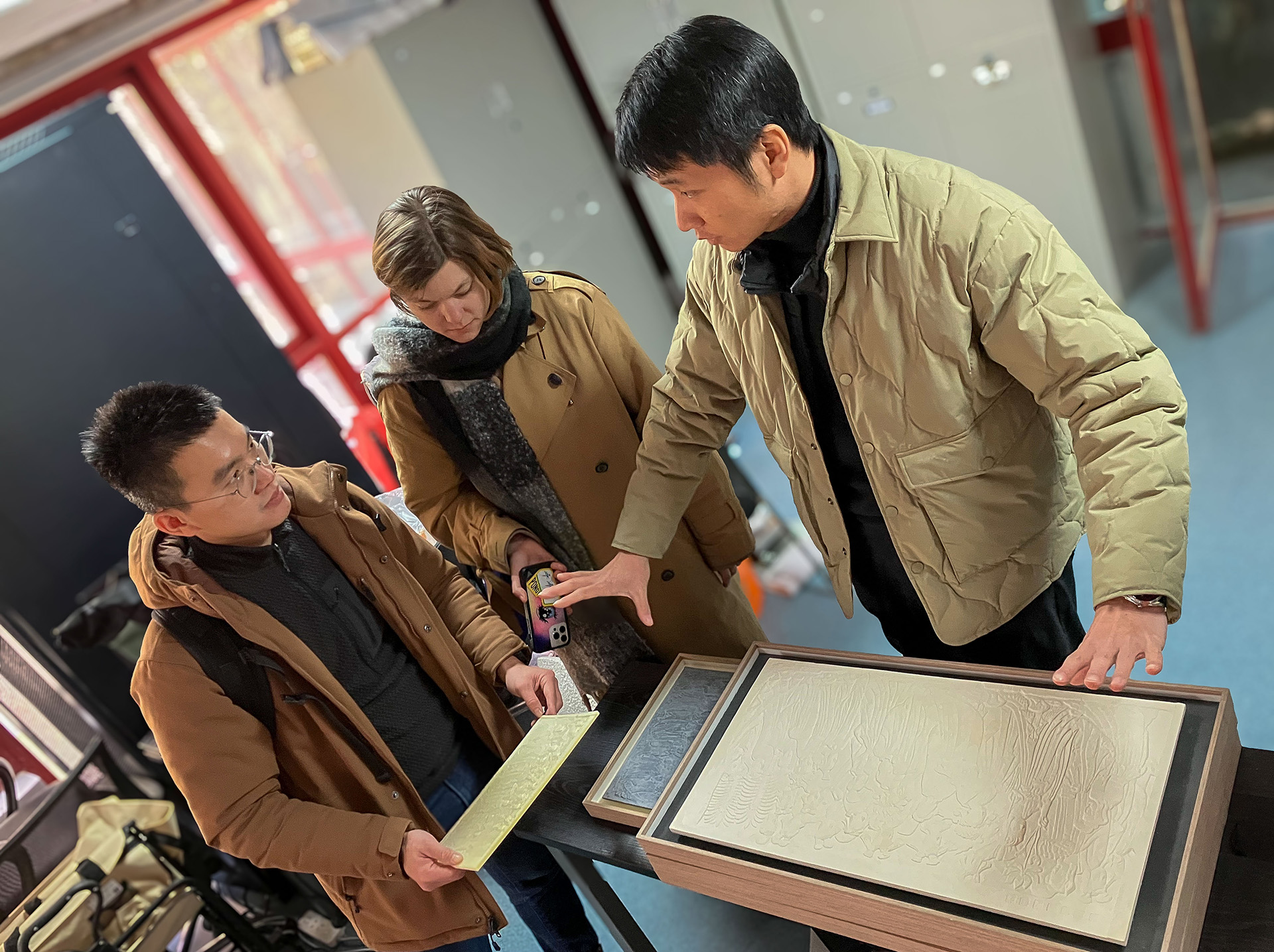
Greg: You’ve been a central figure in the DCADP for several years now. Can you tell us a bit about how you came to be involved in the DCADP and if that has informed your art practice in any particular way?
Ouyang: After graduating, I stayed on at the university to teach and intended to focus on my art practice. I got involved with DCADP mainly to support Professor Jia and help with the project and the team, as I felt it was a valuable and meaningful project that also gave me an opportunity to support my teacher—but in the very beginning, I hadn’t thought about getting involved deeply.
As I became more involved, we had the opportunity to work extensively with the University of Chicago team and communicate and collaborate with many scholars in different disciplines—these varied approaches to research, ways of thinking, perspectives and insights have all greatly broadened my horizons, and helped me avoid the kind of narrow mindset that artists can easily fall into.
As an artist, I find sparks of inspiration only come when the thing that triggers them has real depth or quality. And what I’ve encountered through DCADP has been exactly that—things that are rich, meaningful, and stimulating in a new way.
Greg: Was Buddhism an influence on your artwork prior to the DCADP, or did that come in more recently?
Ouyang: This was before DCADP. I’ve always been interested in philosophy, and early on I was drawn to the Buddhist worldview—what you could call Buddhist philosophy. I think it really sparks creativity and opens up a broader way of seeing the world.
But I never set out with the intention of expressing Buddhist content in my work. It’s more that the Buddhist way of thinking—its worldview—feels inherently creative to me. So I study it, learn from it, and naturally it becomes part of my artistic language. That said, I’m not deliberately trying to make art about Buddhism or illustrate Buddhist ideas. It’s more that its way of thinking naturally flows into my creative process.