Beyond Writing: TJ Ren on Calligraphy
In the historical development of contemporary Chinese calligraphy, TJ Ren 任天进 occupies an unusual position — one shaped as much by decades of international collecting and entrepreneurial practice as by formal artistic training. Since the 1980s, Ren has deepened his calligraphic practice under the scholar-calligrapher Hong Pimu 洪丕谟 in Shanghai and, later, through doctoral studies at the China Academy of Art under Wang Donglin 王冬龄. His recent book, Beyond Boundaries, traces a body of work that refuses easy categorization: traditional ink calligraphy, collaged Heart Sutra fragments, large-scale acrylic landscapes developed with palette knife and pressed botanicals, and three-dimensional sculptural transformations of the written character. In this interview, Ren reflects on the mentors who shaped his practice, the cross-cultural comparisons that animate his calligraphic practice, and the intuitive process behind his most experimental works.
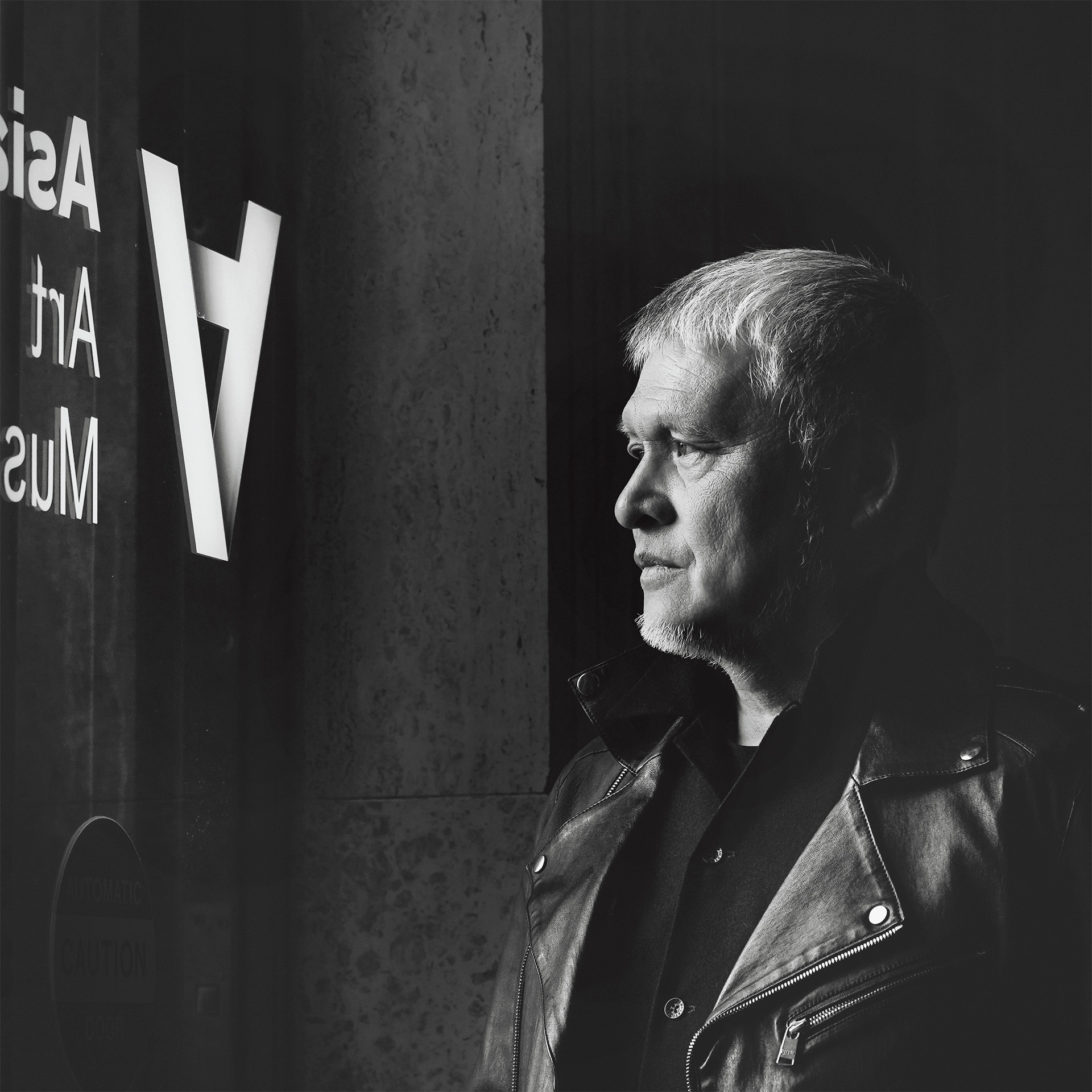
Yuheng Deng: Thank you for agreeing to participate in our interview. Your new book, Beyond Boundaries, truly captures your past work and your unique approach to Chinese calligraphy. What particularly fascinates me is how your work re-negotiates traditional art, finding new contemporary expressions and pushing beyond the boundaries of traditional calligraphic art. Before becoming an artist, you were an entrepreneur. How did you transition, and how has your life as an entrepreneur contributed to your current artistic practice, both in terms of thought and why calligraphy became such an integral part of it?
TJ Ren: Many people know me as an entrepreneur, but most don't realize that before business, I was a collector. I started collecting around 22 and have continued to this day. While I now focus more on my own creations, I still collect new pieces. My approach to art collecting has evolved; it's no longer just about personal preference but about understanding art history and identifying works that truly belong in a collection.
I have a collection of over 1,000 pieces, including works by Picasso, Georges Braque, Matisse, Degas, and Modigliani from the West, and pieces by living artists from the East. My collection also spans from the Republic of China era back to the Ming and Qing dynasties, focusing on ink wash paintings and calligraphy. After moving to the US in the 90s, I traveled extensively in Europe, which further shaped my appreciation for European art.
As for how I became an artist, I've been practicing calligraphy since childhood. In my twenties, my calligraphy mentor was Hong Pimu 洪丕谟, a renowned scholar from Shanghai. He had a profound influence on me; we were friends first, then teacher and student. His family background, particularly his maternal grandfather, Mei Tiaoding 梅调鼎, who was called the "Wang Xizhi of the Qing Dynasty," also played a significant role. I accompanied him to temples where he taught calligraphy and Buddhist philosophy, which back then was categorized under philosophy in Chinese universities.
Yuheng Deng: So, calligraphy was a required subject in your childhood, and Mr. Hong Pimu had a significant influence. He was a member of the Academic Committee of the Chinese Calligraphers Association. You also mentioned another avant-garde Chinese ink artist Wang Nanming 王南溟, who was also a student of Hong Pimu.
TJ Ren: Yes, Wang Nanming and I shared the same teacher. Hong Pimu was not only a calligrapher but also a scholar who published over 100 books. Later in his life, he wrote extensively on numerology, which even influenced scholars like Wang Defeng 王德峰, a Fudan University professor known for his philosophy lectures. My connection to Hong Pimu later led me to pursue my Ph.D. in art studies at the China Academy of Art, where I met Wang Donglin 王冬龄.
I told Wang Donglin that I had known his name since the 80s because Hong Pimu had mentioned him as one of the good calligraphers in Zhejiang. He was delighted and, after seeing my calligraphy, invited me to pursue my doctorate at the Academy. I already had a Ph.D. from France, so the entry requirements were not an issue for me.
Yuheng Deng: During your doctoral studies, you focused on both theoretical research and creative practice. You mentioned that Wang Donglin is more accurately described as an artist rather than just a calligrapher.
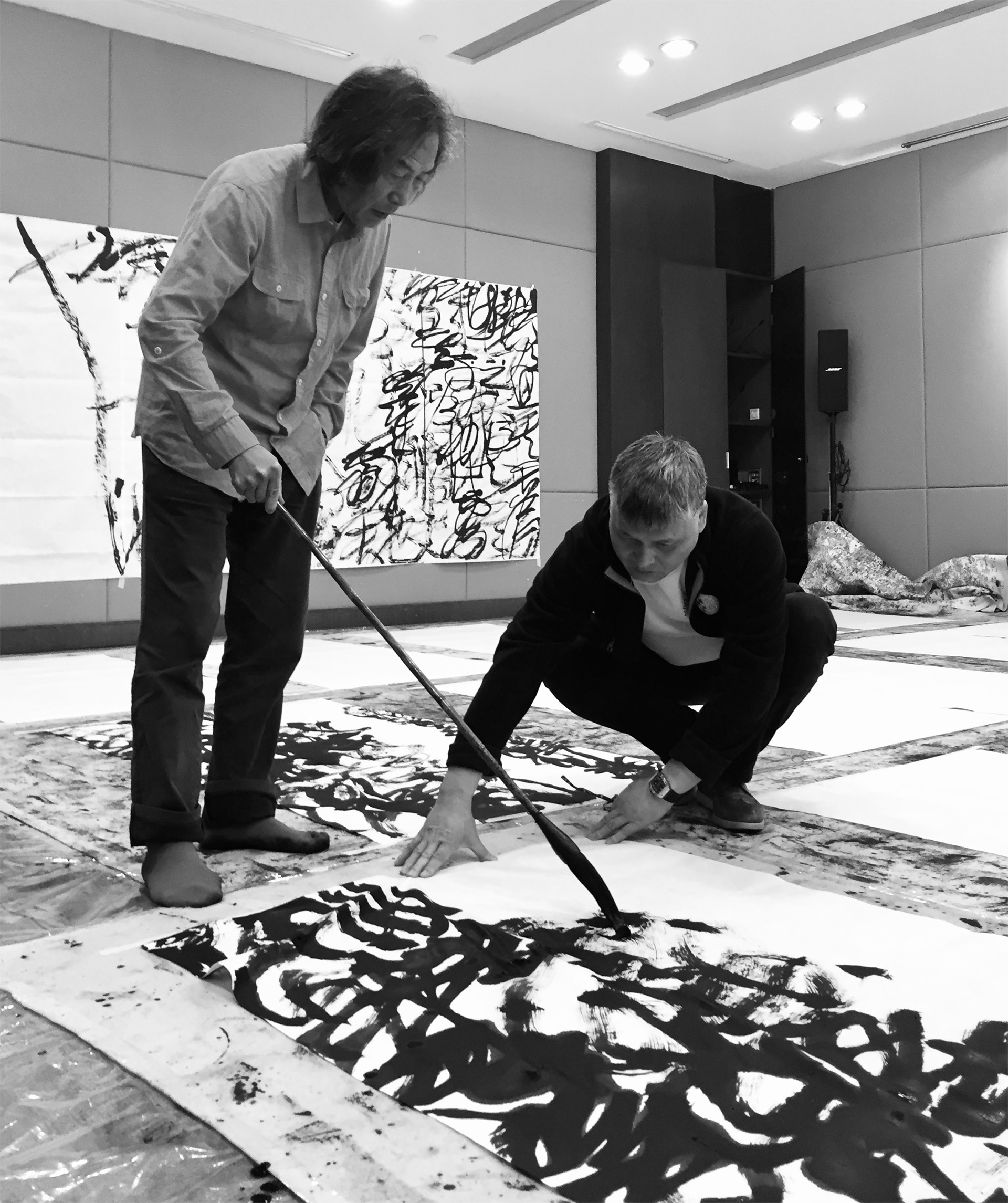
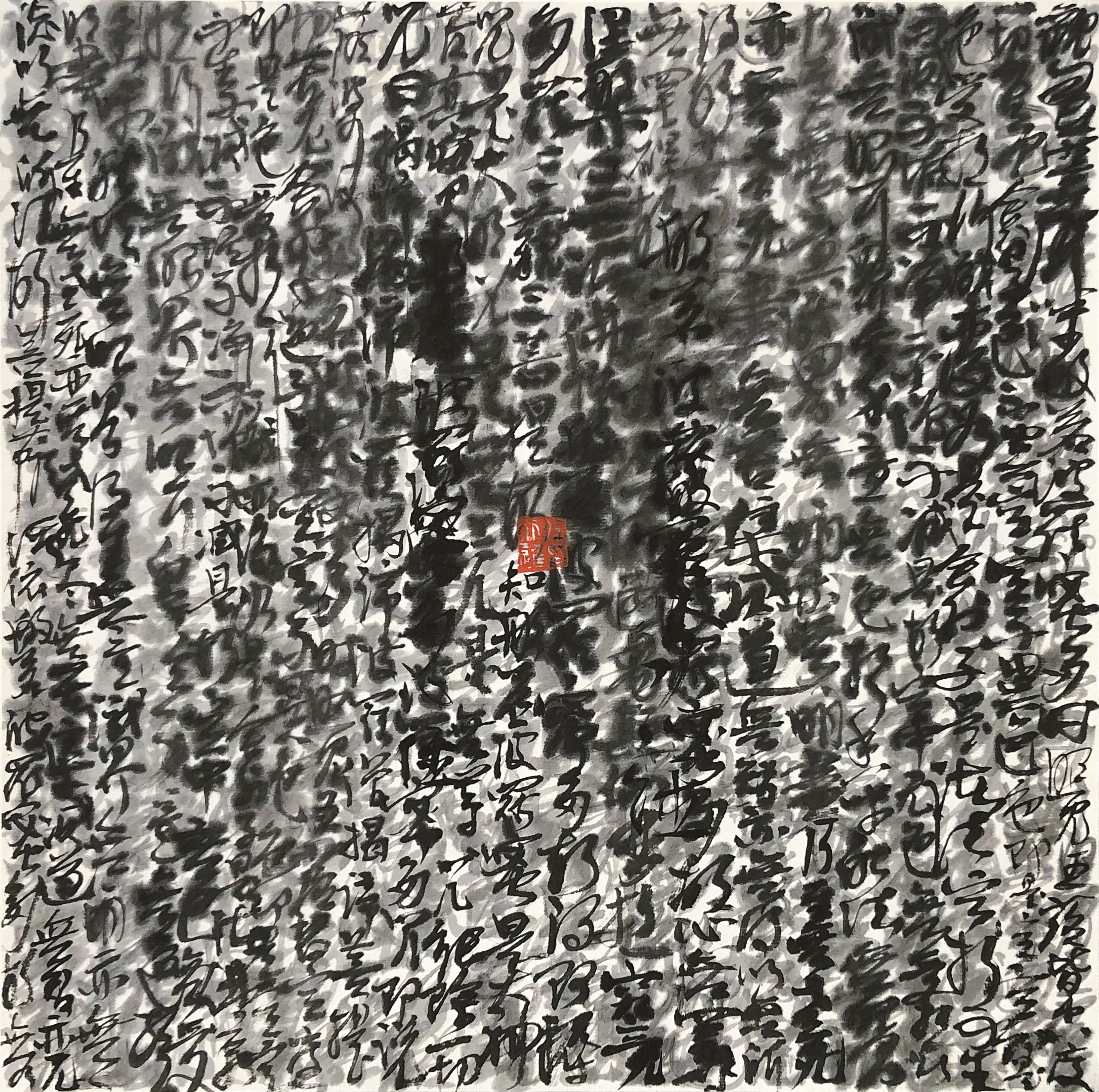
TJ Ren: Absolutely. I spent five years with him at the Academy, and I was fortunate to spend a lot of time with him, traveling to his exhibitions and working in his studio. Observing his creative process, particularly his luanshu 乱書 (chaotic calligraphy), was insightful (Fig. 1). While his work might appear chaotic, each character is a standard cursive script; he simply breaks the traditional spacing between characters and lines, overlapping and intersecting them. If you slow down a video of him writing, you can see the precision of each stroke. This, I believe, is true innovation. He wasn't consciously trying to innovate but rather expressing his interpretation of calligraphy. He's also excellent at traditional styles.
Yuheng Deng: So, innovation requires a firm foundation in traditional skills.
TJ Ren: Exactly. His luanshu isn't about abandoning tradition but about reordering it. The beauty of his lines makes the chaotic arrangement appear like a painting. He's an artist because he works across various mediums — acrylics, gelatin silver print, darkroom techniques, and even different types of ink — to create diverse calligraphic works.
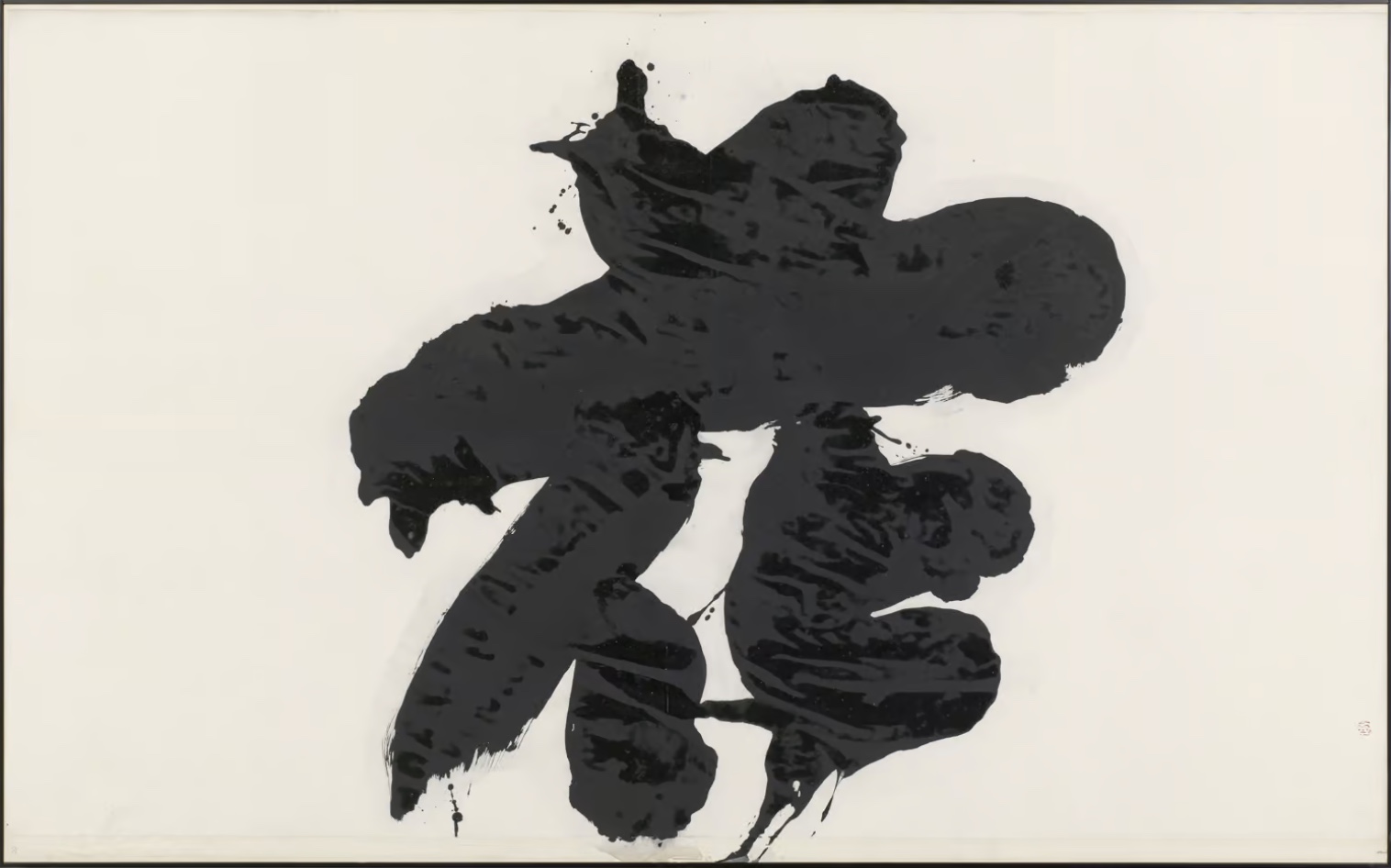
My dissertation, which compares Inoue Yuichi 井上有一 and Wang Dongling, delves into how Chinese calligraphy evolved after 1949 and the Cultural Revolution, while Japanese calligraphy saw significant changes after World War II, particularly with groups like the Bokujinkai 墨人会. Inoue Yuichi's "one-character calligraphy" (ichiji sho 一字書), for instance, broke traditional Chinese calligraphic conventions by often presenting a single character without the usual poetic context or signature (Fig 2 & 3). Westerners often view such works through an abstract lens, while traditional calligraphers might question how calligraphy can be written in such a way. However, Inoue had a strong traditional foundation. His one-character calligraphy often features distorted or inverted strokes, but his Yan style 颜体 calligraphy was exceptional.
Many now imitate his style, but I believe imitation and innovation are not contradictory, unlike plagiarism. I've given lectures on this, using examples from both Western and Chinese art. In Chinese painting, for instance, artists often begin by copying ancient masters. Calligraphy, I believe, is even more challenging than painting because of its concise nature; any deviation is immediately apparent.
Yuheng Deng: Where does the difficulty lie in making and appreciating an exceptional work of calligraphy?
TJ Ren: The degree of variation. While each character's brushwork can vary, some calligraphers, like Qi Gong 启功, have less variation, while others, like Wang Dongling, exhibit incredibly complex and varied brushwork, with lines that can be both soft and hard. To appreciate Chinese calligraphy, one needs a certain cultural foundation; without it, it's hard to judge its quality.
This is similar to how many foreigners, particularly Americans after WWII, initially viewed Japanese calligraphy as mere scribbles. However, artists like Inoue Yuichi and Shiryu Morita 森田子龍 of the Bokujinkai were actively trying to bridge Eastern calligraphic traditions with Western abstract expressionism. Inoue, for example, incorporated his memories of the Tokyo firebombing into his charcoal calligraphy, expressing the emotions of that time.
Yuheng Deng: It's interesting how Japanese calligraphy, particularly the "one-character" or "two-character" Zen ink works, influenced Chinese calligraphy after the ‘85 New Wave.
TJ Ren: Yes, traditional Chinese calligraphy typically involves complete poems or phrases, not just single characters. This shift was likely influenced by Japanese practices.
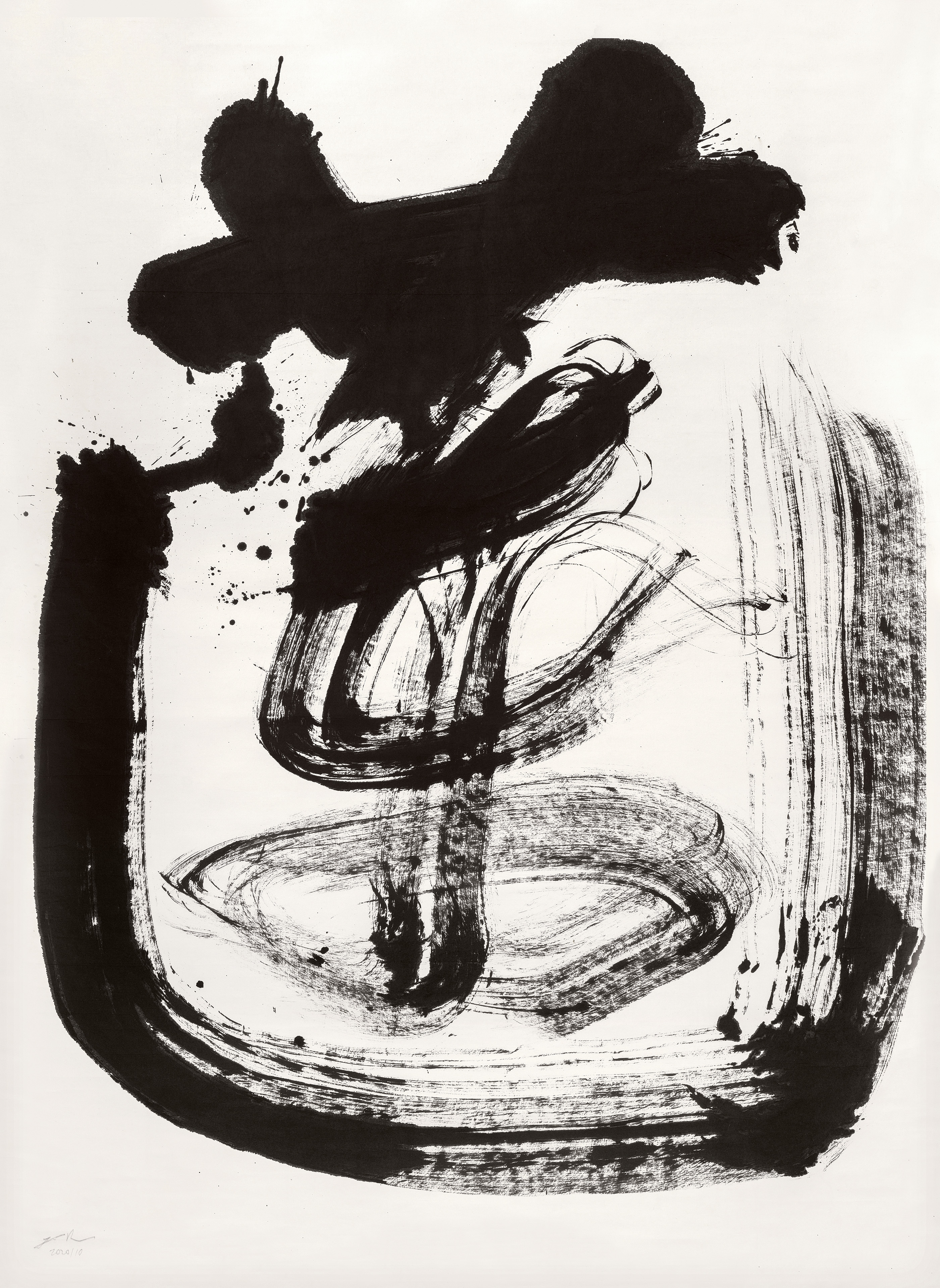
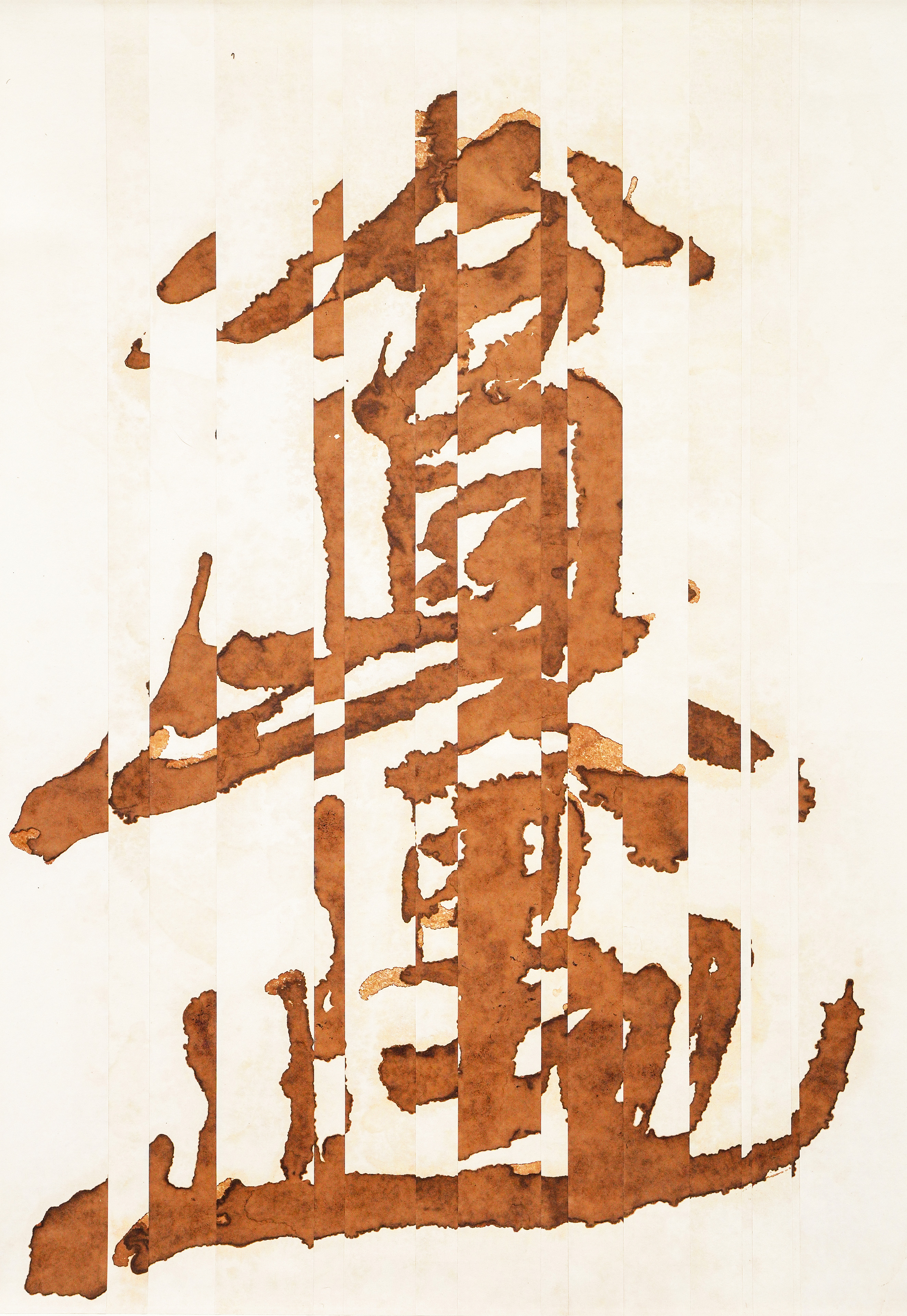
Yuheng Deng: I'm particularly interested in the rich materiality and diverse mediums in your work. You use sculptural forms, collage, and even materials like Pu'er tea as ink (Fig.4), and acrylic landscapes inspired by Song dynasty paintings. What led you to such extensive material exploration?
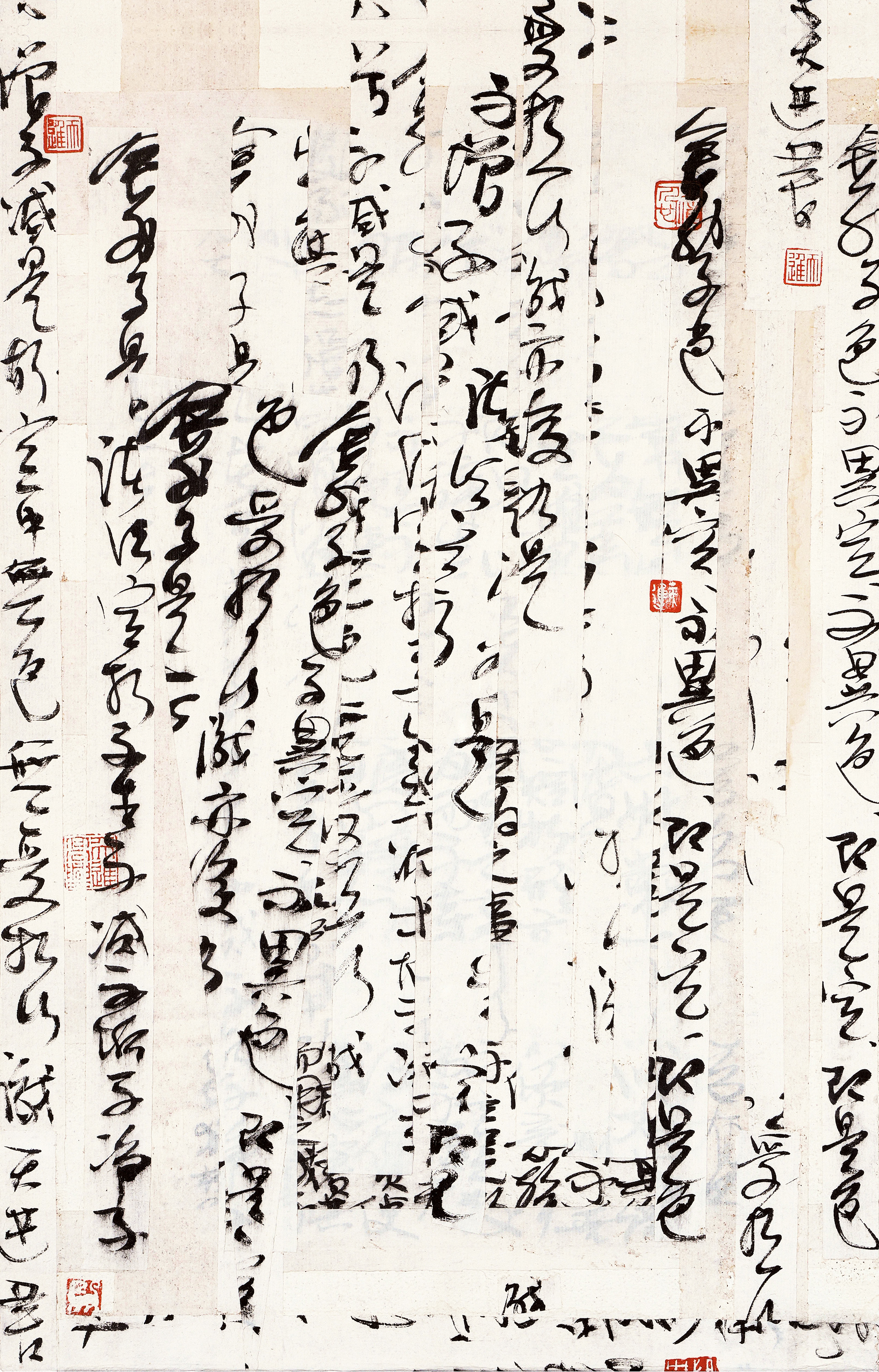
TJ Ren: It's probably related to my personality. When I'm working on traditional calligraphy, I often feel a desire for change. This isn't a premeditated decision but a natural evolution. For example, with my Heart Sutra series, I felt certain phrases were keywords. I would cut out these favorite sections, which were irregular strips, and then paste them onto a canvas.
This idea was inspired by my time with Hong Pimu at Lingyan Temple 灵岩寺 in the mid 80s. Waking up at 5:30 AM, we'd hear the young monks chanting. Their voices were uneven, creating a "chaotic" sound. When I pasted the Heart Sutra fragments, that chaotic image was in my mind. The strips were angled, wide at the top or bottom, creating a free-flowing arrangement (Fig 5). Many loved the resulting piece, but I found it impossible to replicate that naturalness in subsequent attempts. Art, especially my own, is not reproducible because the inspiration and state of mind are unique to that moment.
Yuheng Deng: So, the first piece was strongly influenced by the sounds you heard at the temple. You associate the visual with sound.
TJ Ren: Yes, the sound and image were intertwined in my mind. The wind through the pine trees on the mountain, combined with the chanting, created a sense of fragmented beauty. The cut strips, like tree trunks with text, when reassembled, created a unique, free, yet textual image. It wasn't about expressing a specific message but about capturing that moment.
Yuheng Deng: So, you don't see calligraphy as an end but as a means to express different aspects.
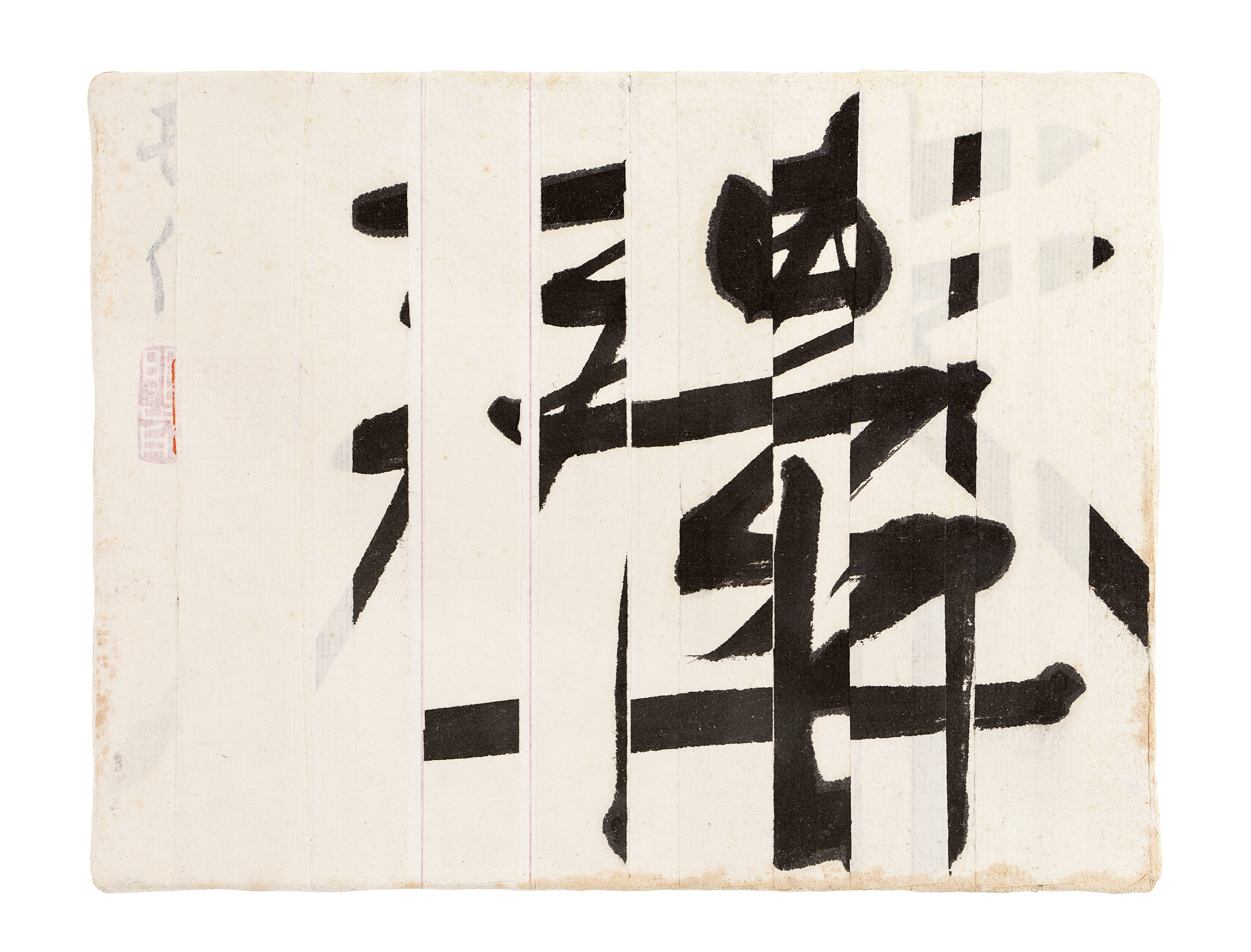
TJ Ren: Exactly. For my "Lichun" 立春 (Beginning of Spring) series, I felt my initial attempts were too flat. So, I cut the characters, placing "Chun" 春 behind "Li" 立 with varying distances, creating depth (Fig 6). This approach was well-received. Another Heart Sutra piece used a "wet on wet" technique, applying thick ink over thin, still-wet ink (Fig 7). This creates a unique blend and penetration of inks, unlike simply layering dry ink. This technique was also inspired by that "chaotic" scene.
I don't repeat my works too much. For me, an artwork has its own lifespan. Once it's done, it's done. Otherwise, it becomes a craft that can be endlessly reproduced. That's why my portfolio, even over a relatively short period of six years, shows such diverse works. I move on once a piece is complete.
Yuheng Deng: That's very interesting. As a collector, you own both Chinese calligraphy and Western art, including sculptures by Modigliani. How have these Western art pieces in your collection influenced your own creations?
TJ Ren: There's no direct influence. His art is his, and mine is mine. I also rarely visit exhibitions.
Yuheng Deng: You rarely visit exhibitions?
TJ Ren: Yes, I try to avoid them to prevent being influenced by others. People often say my work is unique because I haven't seen it myself either. I try to avoid external influences. While some artists draw inspiration from exhibitions, my extensive collecting experience has already given me a deep understanding of various styles. I don't want to deepen that further, as it might influence my originality.
Yuheng Deng: I understand. Another series I'd like to discuss is your acrylic landscape series. How does this relate to your calligraphy practice and training?
TJ Ren: In recent years, I've done quite a few. Initially, I used acrylics on canvas to create abstract calligraphic lines with a palette knife, without forming actual characters (Fig 8). Later, I incorporated characters, sometimes obscuring them with white paint to create a subtle, "flickering" effect. For an exhibition in Beijing, I created an 8-meter long piece using black paint, then covering it with white, allowing the shadows of the black to show through.
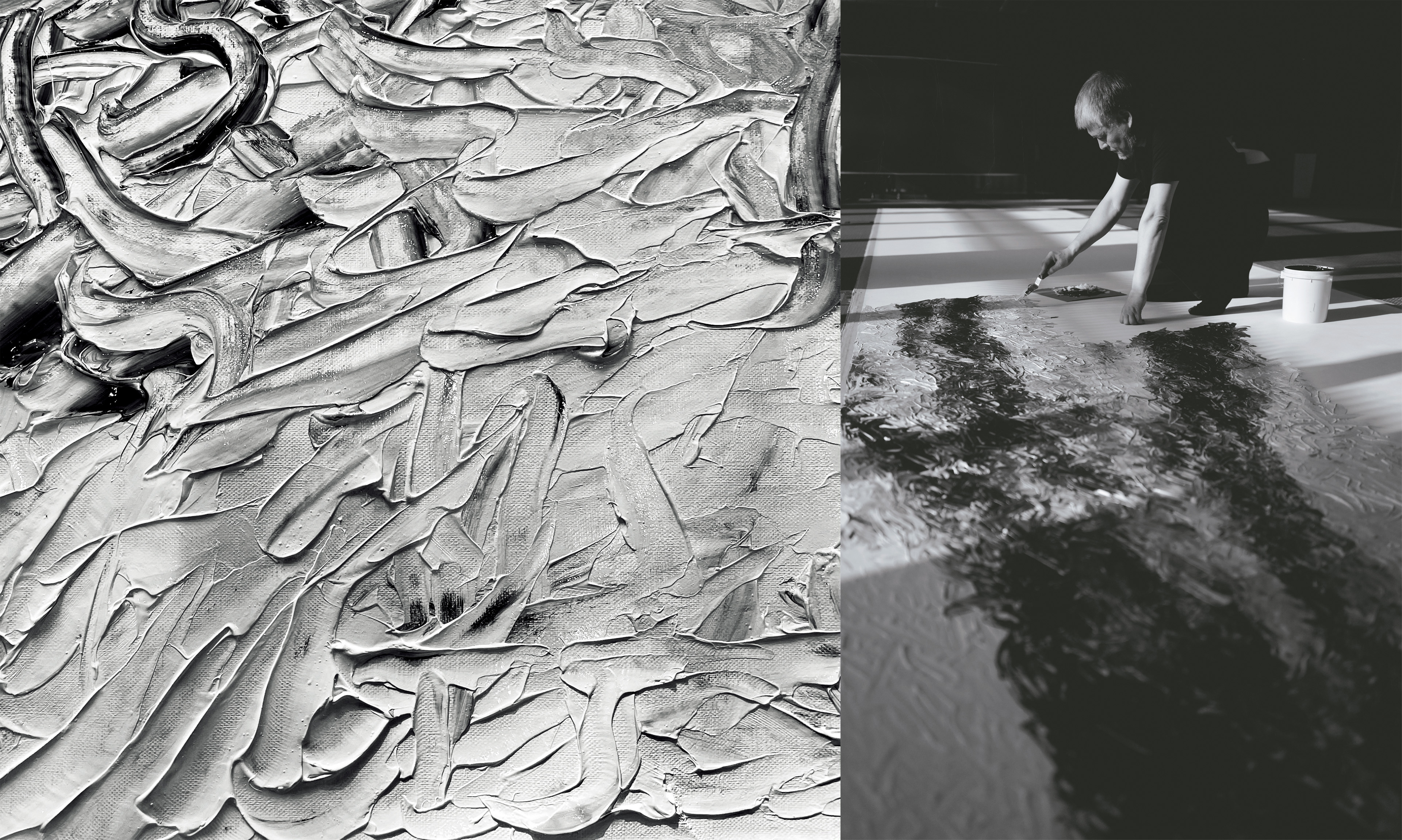
Some of these pieces appear to have characters, but they are often unintentional. The work takes a long time, and I don't use sketches. The characters emerge naturally. In one piece, a line I scraped with a knife reminded me of a Picasso ceramic plate I own — a face. It was a subconscious influence (Fig 9).

Yuheng Deng: The title of this work, L'Orangerie is interesting, referencing the museum known for Monet's large-scale lotus paintings.
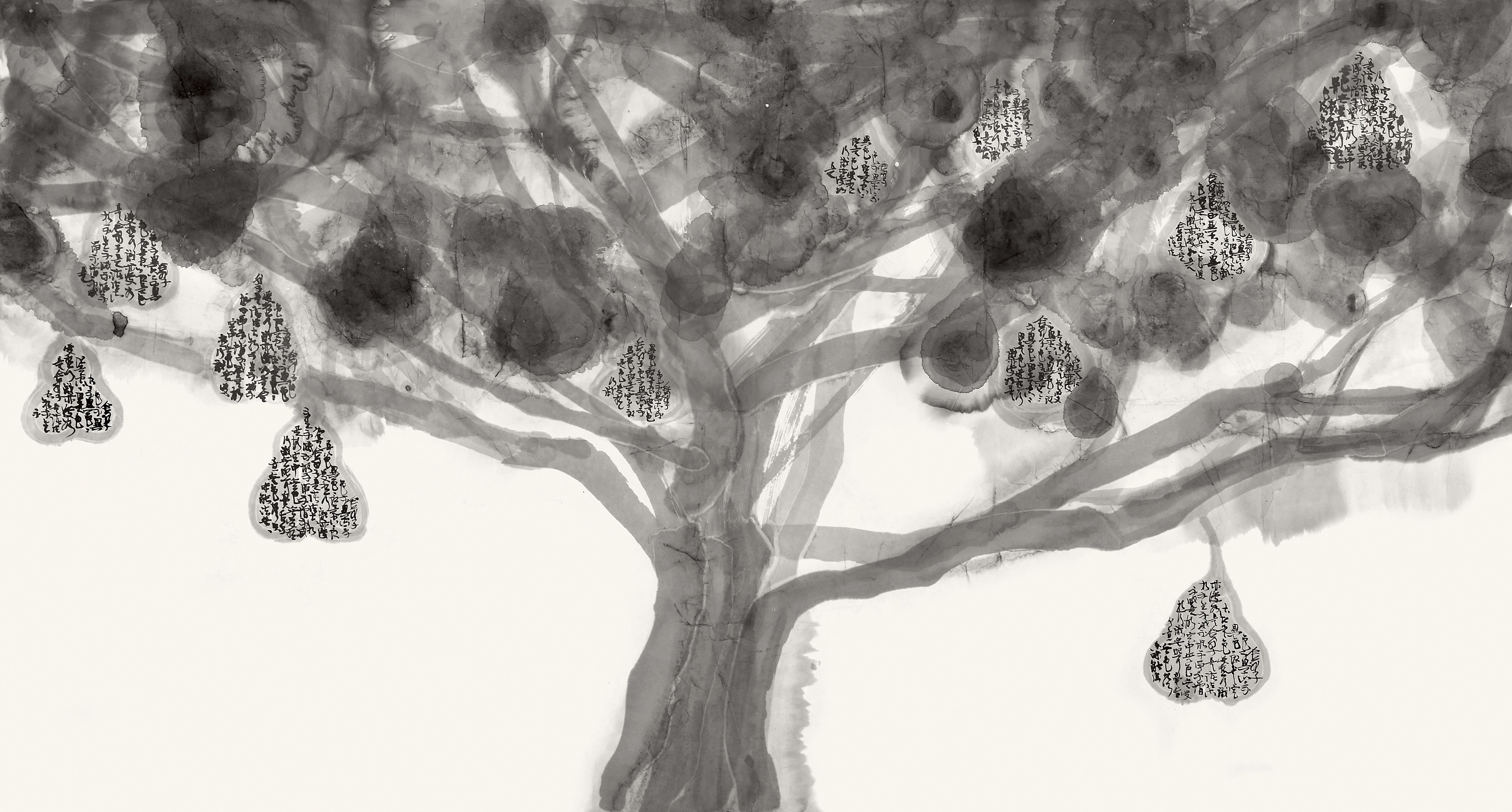
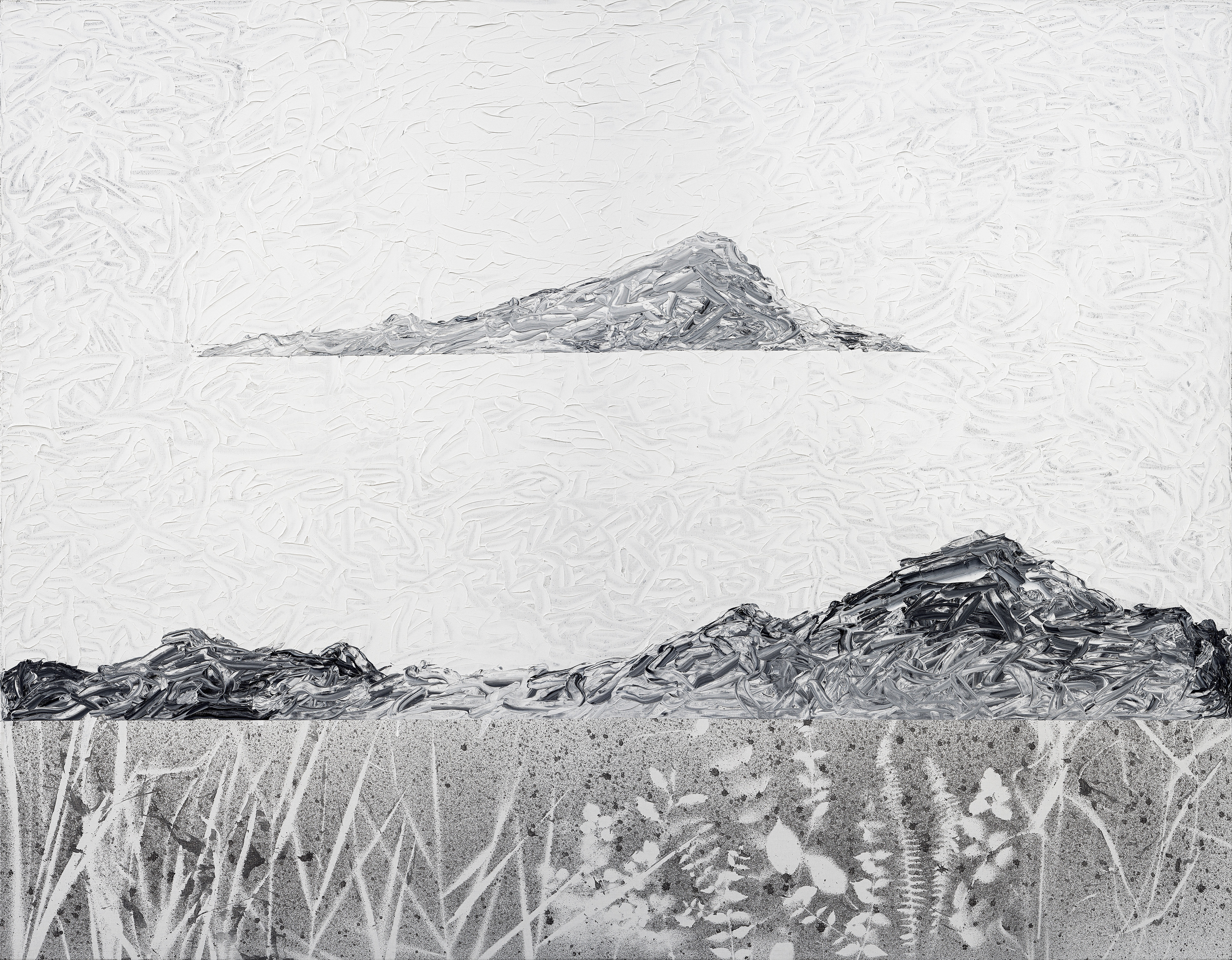
TJ Ren: Yes, it's like a garden. Another piece, inspired by Zhao Mengfu's 赵孟頫 mountains, was created with oil paint on canvas. The background is filled with calligraphic lines. For the foreground, I impulsively gathered flowers and plants from the roadside, sprayed them with a dark color, and pressed them onto the canvas (Fig 10). This took only 40 minutes.
At an exhibition in Hangzhou, a 16-meter long piece I created using this method was praised by Song Lin, an artist friend of mine, who said, "We all know how to do this, but no one has ever done something like this before ." I think it's because I haven't been constrained by formal art education. I can create freely. That 16-meter painting was completed in 45 minutes.
Yuheng Deng: The temporality of your work is also quite interesting. It’s very quick.
TJ Ren: Yes, and I do it without conscious thought. When I create, my mind is empty.
Yuheng Deng: It's like improvisation. You don't overthink.
TJ Ren: Exactly. I never overthink.
One year, I saw Fan Kuan's 范宽 Travelers on a Mountain Path at the National Palace Museum in Taipei. I bought a complete set of reproductions of Song dynasty paintings, which I often revisit. I'm particularly drawn to Song dynasty art because of its sophistication. For some of my Song-Yuan inspired pieces, I use a gold background as a tribute, symbolizing the "high-class" nature of the era.
Sometimes, I stop a painting halfway, feeling that further work would not improve it. This aligns with the concept of "unfinished art" in early 20th-century modernism, where artists decide a work is complete even if others perceive it as unfinished. I didn't know about this theory when I started, but later, I realized my practice resonated with it.
For example, the French ambassador to India commissioned a piece from me. I went to India with only black and white paints and a palette knife. I combined elements from Fan Kuan's 范宽and Li Cheng's 李成 mountains, creating a "cross-temporal encounter." (Fig 11) At the dinner, Vikram Seth, a renowned Indian novelist, recited Wang Wei's 王维 poem, "Empty mountains, no one to be seen." The ambassador, who spoke Chinese, completed the second line, "Only human voices heard." It was an incredible moment.
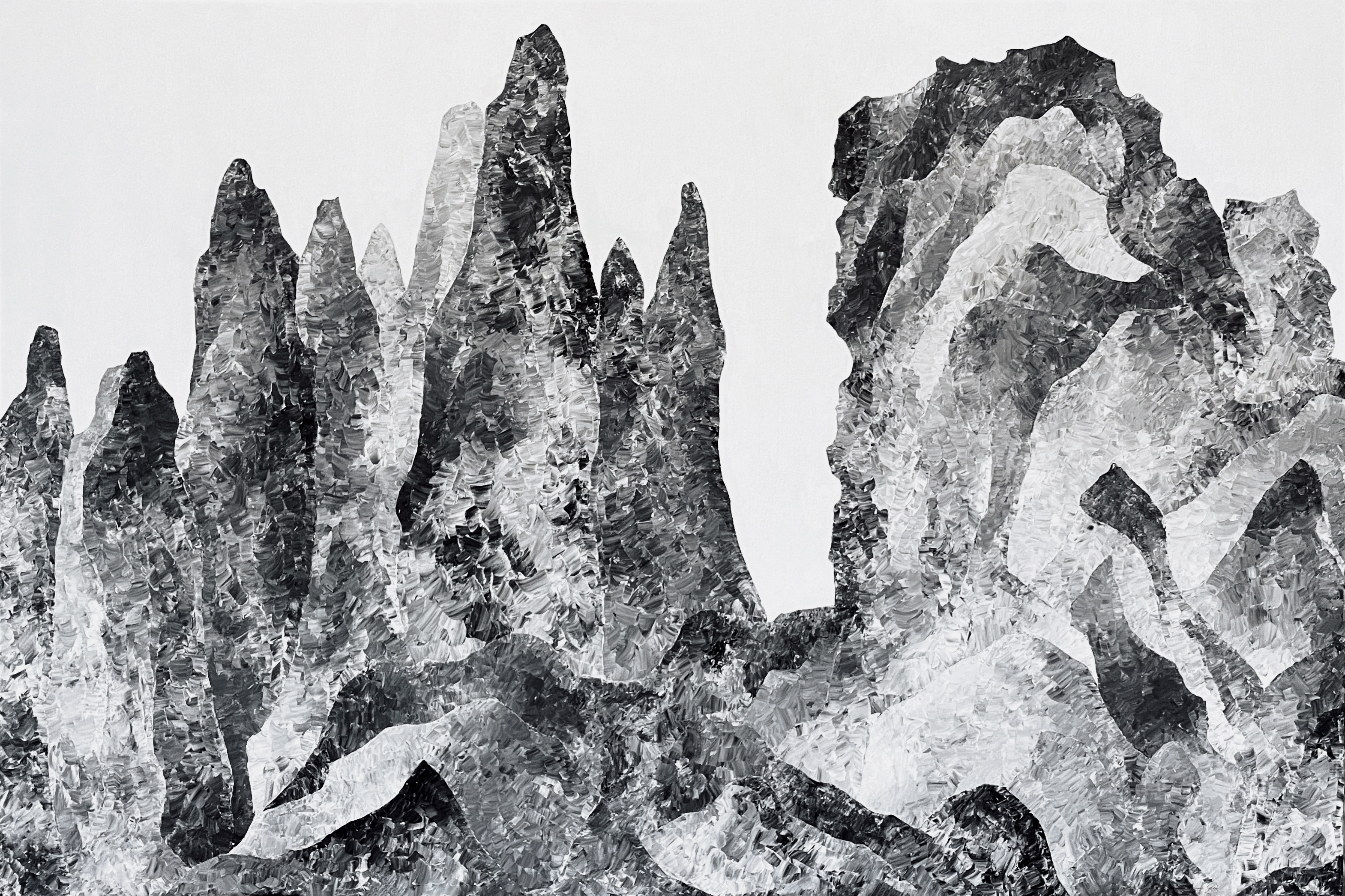
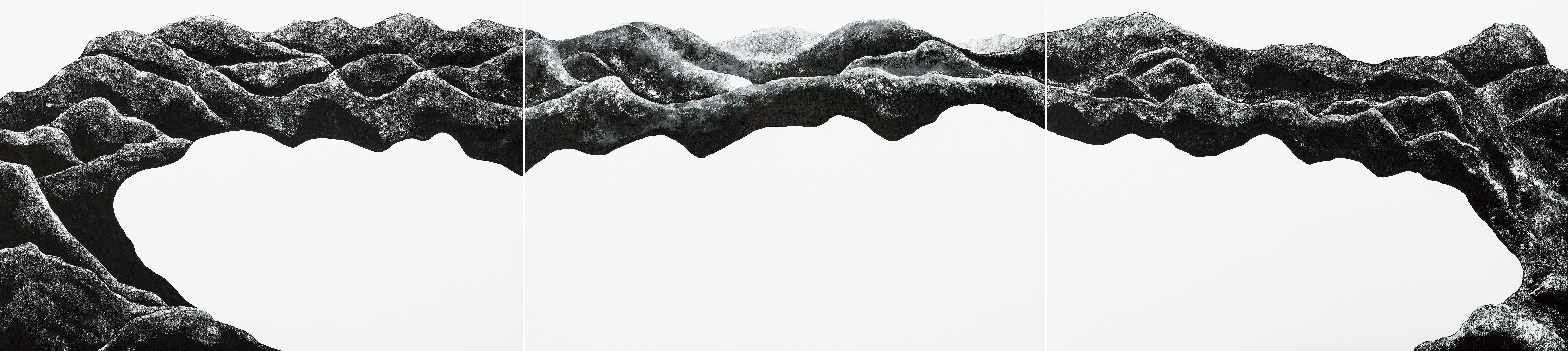
Another large piece, nine by two meters, appears like ink wash but is acrylic on canvas. I started with the middle section, and after a few days, I felt that continuing would make it too heavy. So I stopped. Later, I realized the large empty spaces were essential, making it feel like a fragment rather than a complete, heavy painting (Fig 12).
Yuheng Deng: This creative process makes me think that a good artist knows when to stop.
TJ Ren: Yes, and I never use sketches. It's all improvisation, following the flow until I feel it's complete. This natural approach is a key characteristic of my work. In some of these paintings, you can see contour of a female body. I didn't consciously intend this, but when someone pointed it out, I realized that mountains are like the earth, and the earth is like a mother, so it makes sense to see bodies within.
TJ Ren 任天进 Born in Shanghai in 1962, Ren Tianjin has lived and worked between China and the United States since the 1990s. His artistic practice ranges from Chinese calligraphy to painting and sculpture. He is committed to the innovative creation of contemporary calligraphy and art, aiming to show the collision, communication, crossing and parallels between cultures and ideas. Ren’s works are held in the collections of numerous renowned museums, art academies, prestigious institutions, and prominent collectors, including the Asian Art Museum of San Francisco, the Art Institute of Chicago, Shanghai Museum, China Academy of Art, The Art Museum of Shanghai University, SIIC Shanghai, Ping An Group, Dowell Group, Aston Martin Lagonda Limited UK, RGE Singapore, Moleskine, Porsche, BMW, Garfunkel Foundation, Morgan Stanley Art Collection and other institutions.
Deng Yuheng is a scholar and curator specializing in East Asian art. He holds an MA in the Humanities with a concentration in Art History and Curatorial Studies from the University of Chicago. His work bridges academic research and museum practice, with a focus on fostering cross-cultural dialogue and expanding the global understanding of East Asian visual culture.