
The Six Steeds of Zhaoling: Recovering an Original Spatial Form

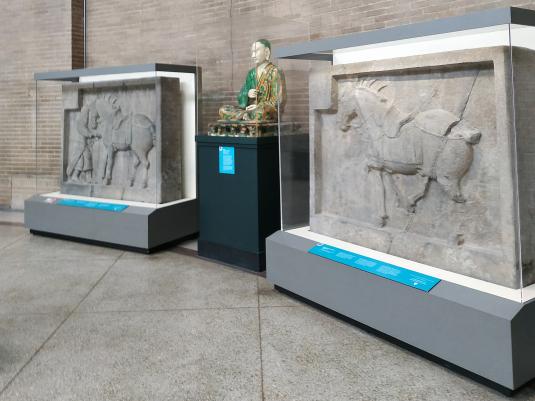
Adapted from a peer-reviewed paper with the author’s permission. Note, the original paper on which this is based was published before the Xi’an Beilin Museum’s 2025 renovation. The new installation (see above) presents the horses in a more screen-like fashion, but the sides and backs are still blocked from view.
If you visited the Xi’an Beilin Museum before 2025, you would have found four stone carvings of war horses set into a wall, lined up in a row. Two more are displayed in glass cases at the Penn Museum in Philadelphia. Together, these are the Six Steeds of Zhaoling (昭陵六骏)—among the most celebrated works of Chinese sculptural art. For generations, scholars have described them as a group of finely carved relief sculptures. Recent research suggests that description may be fundamentally incomplete.
The Six Steeds, this article argues, are more accurately understood as stone screens—freestanding, three-dimensional objects originally mounted on multi-tiered pedestals, viewable from all sides, and installed as spatial elements within an architectural complex. Understanding them only as reliefs risks obscuring their monumentality, their ceremonial function, and the spatial logic that governed their creation.
This article, adapted from a longer peer-reviewed study, examines the question through three lines of inquiry: how the current museum displays, shaped by historical circumstance, may limit our understanding of the original works; how the carved surfaces themselves diverge from the Western concept of relief; and how digital reconstruction can help recover the original spatial context that has been lost over centuries.
What We See Today—and What We May Be Missing
The Six Steeds were carved in the early Tang dynasty as commemorative monuments for Emperor Taizong (r. 626–649), depicting six warhorses that carried him through campaigns preceding the foundation of the dynasty. Each stone panel is roughly 2 meters wide, 1.7 meters tall, and 0.4 meters thick. They originally stood in the east and west galleries flanking the Northern Sima Gate of the imperial Zhaoling mausoleum, on the slopes of Jiuzong Mountain in Shaanxi Province.
Their modern history is turbulent. In 1914, the antique dealer C. T. Loo facilitated the sale and transport of two steeds—Saluzi (飒露紫) and Quanmaogua (拳毛駧)—to the United States, where they have been at the Penn Museum ever since. The remaining four survived but were moved from the mausoleum site during the Republican era, buried underground during the Second Sino-Japanese War to protect them from air raids, and eventually installed at the Xi’an Beilin Museum after 1949.

At the Beilin Museum, the four originals and two modern replicas were embedded into the west wall of the Stone Carving Art Gallery in 1963, where they remained in the wall until the museum’s renovation in 2025. This arrangement presented the carved front surfaces but concealed the pedestals, the lateral thickness faces, and the backs of the stone panels—all of which are part of the original works. The result is that viewers encountered the Six Steeds as wall-mounted compositions rather than as freestanding objects in space.
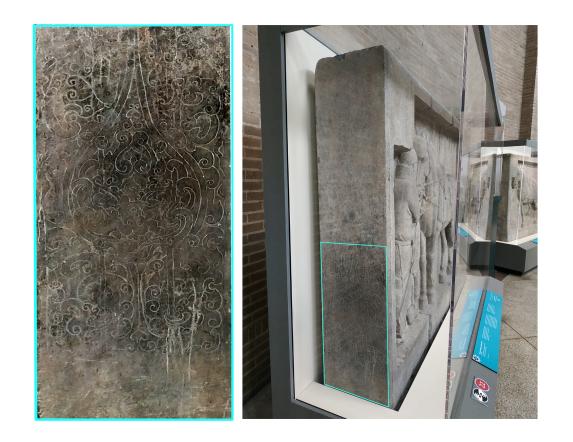
At the Penn Museum, the two steeds are presented in glass display cases that support the full stone panels, offering a different perspective on the objects. The lateral thickness faces are visible, and on-site research for the original study revealed a section of previously undocumented line-engraved ornament on the lower-left side of Saluzi—a detail that would not be accessible in a wall-embedded configuration. However, as with the Beilin Museum display, the screens cannot be viewed from all sides, and the spatial relationship among the six works—their mutual orientation, spacing, and dialogue with the surrounding architecture—is absent.
Relief or Screen? A Conceptual Distinction
The difference between a relief and a screen is not merely terminological—it is spatial. A relief sculpture projects from a flat back-panel, typically adhering to a wall or other substrate; it operates within a fundamentally planar logic. A screen, by contrast, is a quasi-architectural object: it occupies three-dimensional space, divides it, and can be approached from multiple angles. In Chinese tradition, the screen (屏风) is also one of the oldest known formats for painting and symbolic imagery.
The practice of carving imagery on stone screens in mausoleum settings has deep precedent. The Commentary on the Waterways Classic (水经注) describes stone screens at the Northern Wei Yongguo Mausoleum (late 5th century) bearing low-relief images of Confucian virtues—one of the earliest known instances of carved stone screens in Chinese funerary architecture. The Six Steeds of Zhaoling stand within this tradition, differing primarily in subject matter.
Historical sources also illuminate how much of the original ensemble has been lost. The Tang-dynasty calligrapher Ouyang Xun executed the horse names and eulogies in a reserved panel on each stone; Emperor Gaozong later commissioned Yin Zhongrong to add further inscriptions on the pedestals themselves. The Song-dynasty official You Shixiong, who personally inspected the stones, noted that the horse names and eulogies were all on the pedestals, and reported that the calligraphy of Ouyang Xun was no longer visible — only the characters of Yin Zhongrong survived. Today, none of these inscriptions can be seen at all; they have been scattered and lost.
A Carving That Challenges the Conventions of Relief
If the Six Steeds differ from reliefs in their architectural function, do they also differ in sculptural terms? A close examination of the carved surfaces suggests they do—or at least, that they operate according to a different set of spatial principles than those governing Western relief sculpture.
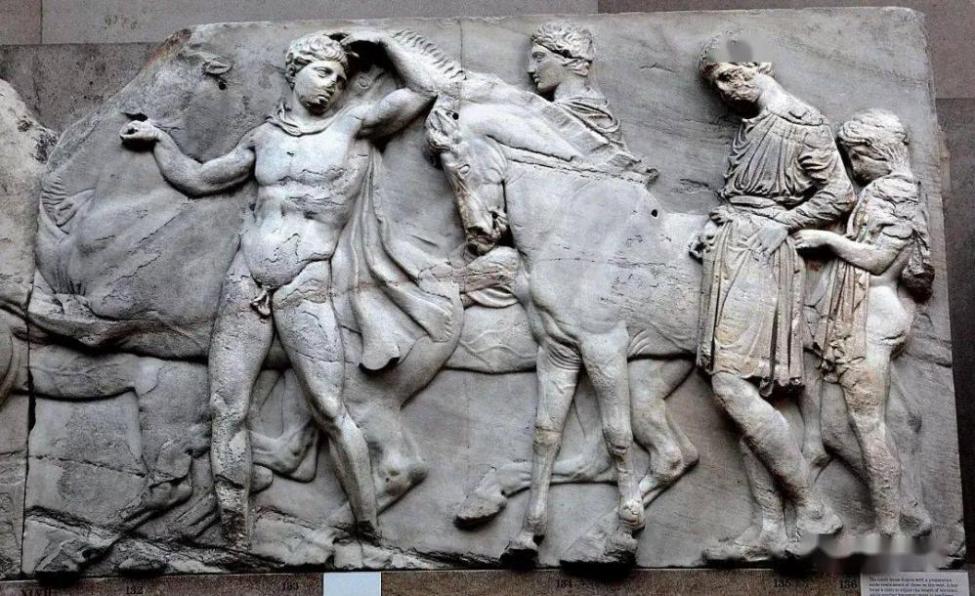
In the Western tradition, a relief sculpture operates according to a strict spatial logic. The back panel establishes a uniform datum plane—the lowest point of the formal space. All forms are compressed systematically between this datum and the front surface. The planarity of the back panel is the governing principle.
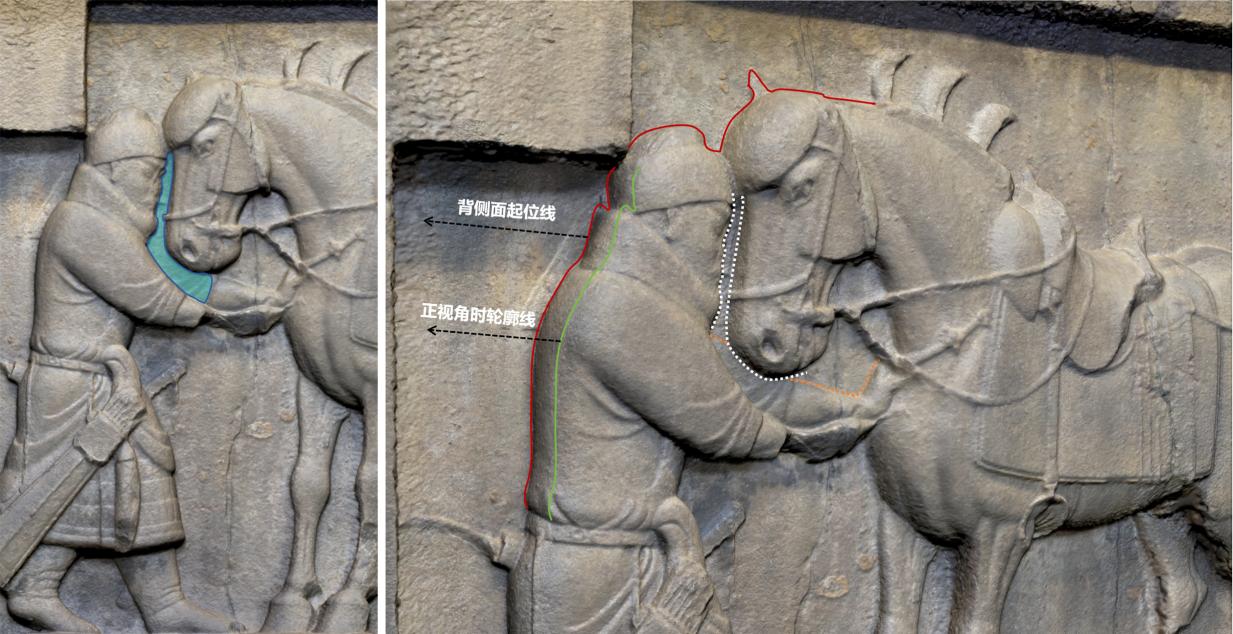
Saluzi—the only panel to include a human figure, the general Qiu Xinggong removing an arrow from the horse—provides the clearest evidence. By inserting cross-sectional planes into the three-dimensional scanning data, we found that the carving has two distinct base levels, separated by approximately 4 cm. In the area around the faces of figure and horse, the back panel rises well above the overall datum. This raised area absorbs the spatial allowance that might otherwise have been available for modeling Qiu Xinggong’s left upper arm, which is consequently rendered as a flat outline rather than a raised form.
The reverse also occurs: in the area of the figure’s abdomen and the horse’s chest, the back panel drops below the overall datum, apparently because the carver needed additional depth to manage the overlapping volumes of figure and horse.
The study argues that this reflects a different set of artistic priorities. In the Six Steeds, line carries the primary expressive function that space carries in Western relief. Forms are articulated through the interlocking and overlapping of contour lines, with thickness added adaptively rather than according to a systematic compression scheme. The result is a spatial logic that is internally consistent but distinct from the Western concept of relief.
This is not a deficiency but a different artistic system, one in which line possesses an independent aesthetic status—functioning not as the boundary of a compressed volume but as an expressive element in its own right. To describe the Six Steeds simply as “reliefs” without further qualification may be to measure them against a framework they were not designed to operate within.
Recovering What Has Been Lost
If the Six Steeds are stone screens rather than wall reliefs, what did they originally look like as complete objects in space? The original study undertakes a digital reconstruction of the full ensemble—screens, pedestals, and architectural setting—combining 3D scanning, archaeological evidence, and historical documentation.
The Pedestals During the 2002–2003 excavation of the Northern Sima Gate site, archaeologists unearthed one complete first-tier pedestal stone for Baitiwu (白蹄乌), along with fragments of a second tier. From these remains, the study infers a three-tiered pedestal system: a large foundation stone (2.7 × 1.1 × 0.3 m) set flush with the ground; a second tier with a longitudinal channel for receiving the screen; and a third tier—now entirely lost—that held the stele body and likely bore the inscriptions recorded in historical sources.

The reconstruction is necessarily approximate—the third tier’s height, in particular, can only be estimated from visual proportion—but it substantially changes our picture of these objects. A Six Steeds stone screen was not a flat panel; it was a freestanding monument, standing on multi-tiered pedestals, viewable from all sides, with carved imagery on the front, ornamental line-engraving on the sides, and inscriptions on the base.
The Architectural Setting The stone screens stood in a pair of terraced galleries flanking the Northern Sima Gate—a major north–south axial complex on the north slope of Jiuzong Mountain. Drawing on the most complete published reconstruction of the gate complex, the study models the galleries as stepped structures descending the hillside, each bay dropping approximately 40 cm in elevation.
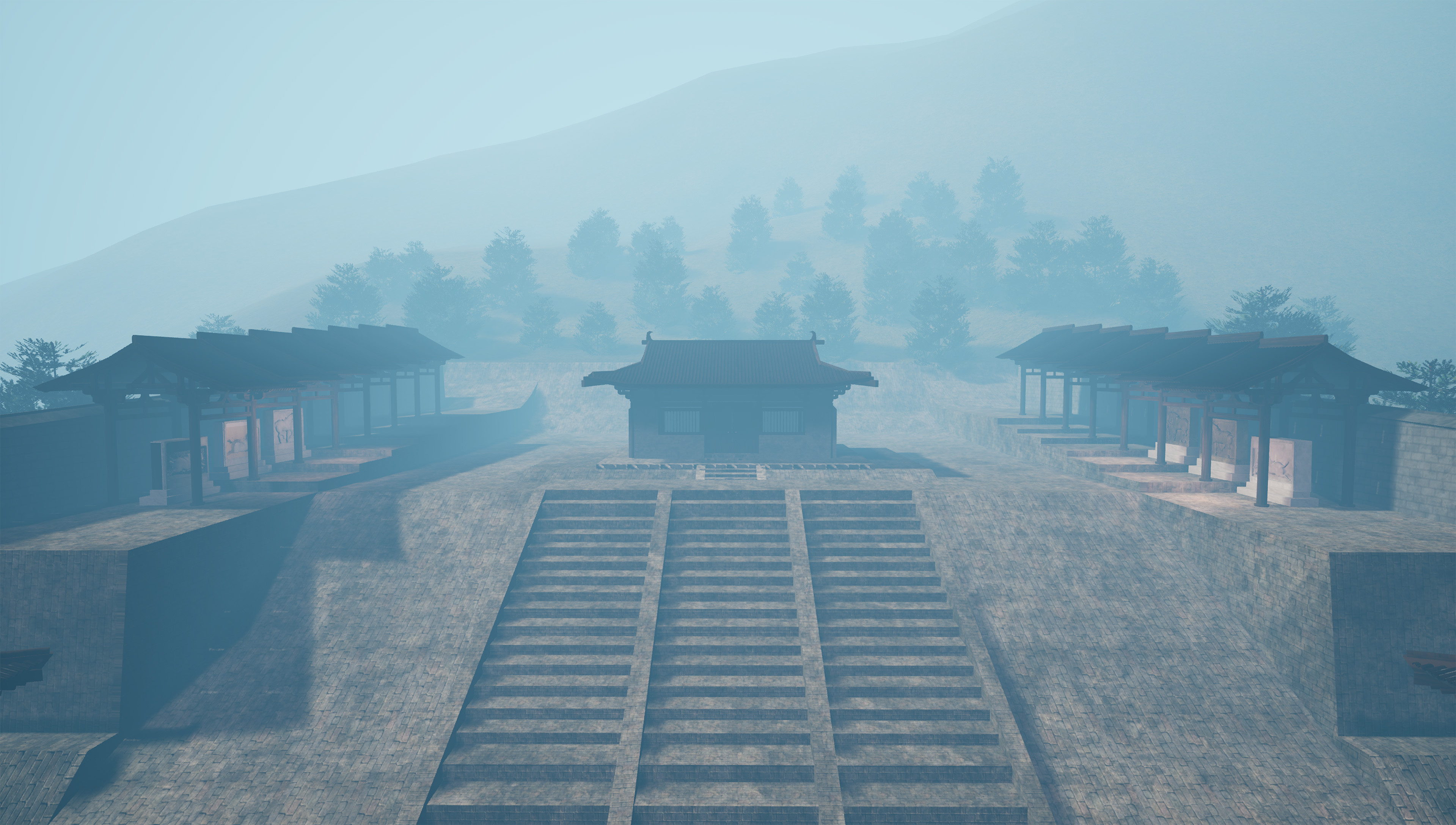

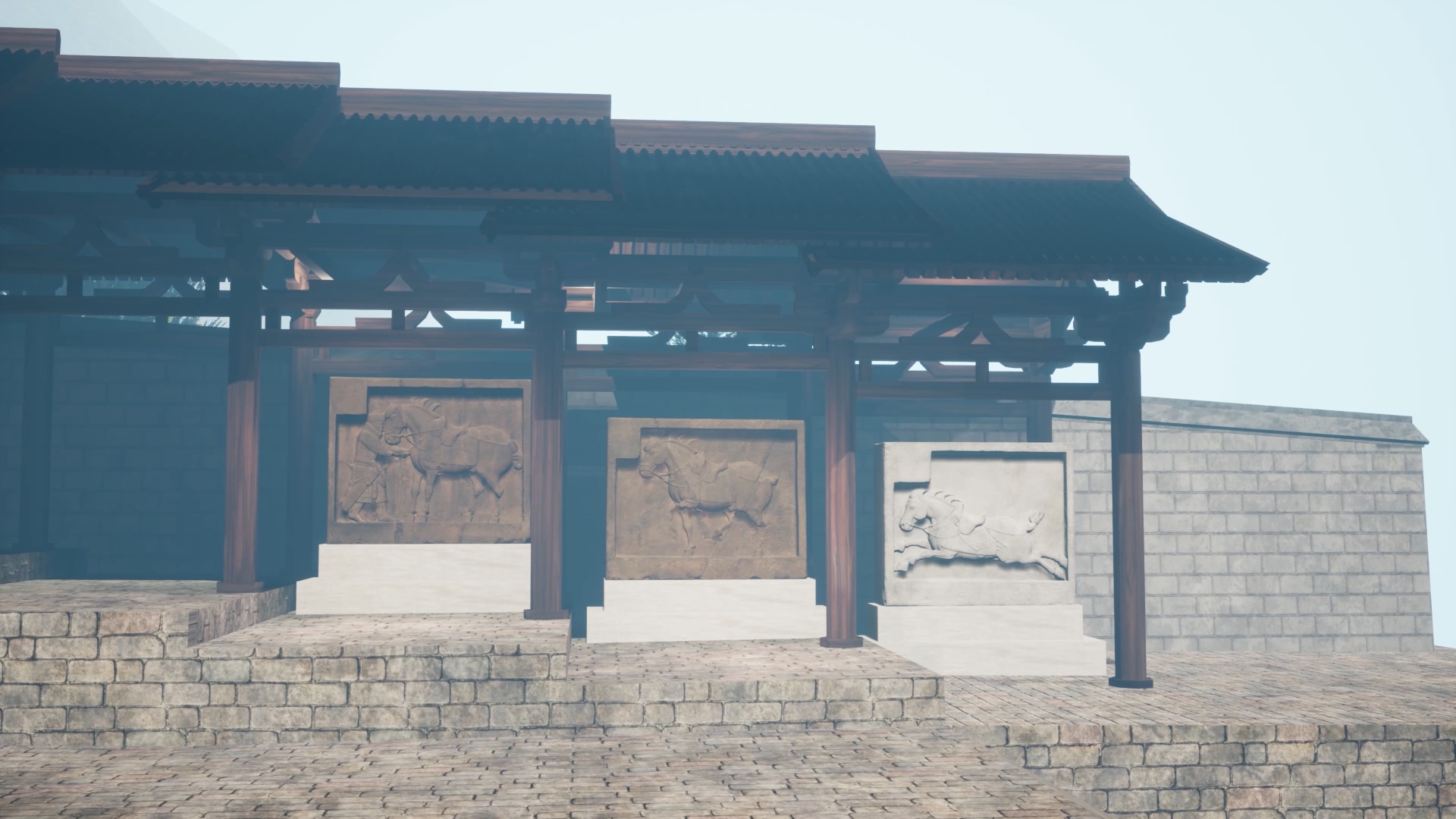
The six screens were arranged three to a side, facing each other across the approach to the gate, with the horses’ heads all pointing south. According to the Song-dynasty Stele of the Six Steeds, the west gallery held Baitiwu, Quanmaogua, and Saluzi (from north to south); the east held Shifachi, Qingzhui, and Teqinbiao.
In this configuration, the screens did not merely depict horses—they structured a space. A visitor standing between the galleries would have been enclosed in a corridor of monumental imagery: six warhorses facing inward, framing a commemorative space shaped by the memory of the emperor’s campaigns. The screens divided space, directed movement, and created what the original study describes as a kind of four-dimensional experience—three dimensions of space interwoven with the temporal dimension of historical memory.
Toward a More Complete Understanding
When the Six Steeds are understood only as relief sculptures—whether due to the conventions of art-historical classification or the practical constraints of museum display—important dimensions of the original works are necessarily left out of view: the pedestals and their inscriptions, the lateral carvings, the three-dimensionality of the objects, the spatial logic of their arrangement, and the ceremonial role they played within the architecture of the mausoleum.
Recovering these dimensions, even partially, through digital reconstruction offers a way of understanding these works more fully—not as a replacement for direct engagement with the physical objects, but as a complement to it. Digital methods allow us to test hypotheses about original spatial form against archaeological evidence, to visualize configurations that no longer exist, and to share those visualizations across institutional and national boundaries.
The case of the Six Steeds also invites broader reflection. How many other works of Chinese sculptural art might benefit from reexamination through the lens of spatial form? What other works have been shaped, in our understanding, by the display contexts in which we happen to encounter them? These are questions that extend well beyond a single monument, and that the growing field of digital cultural heritage is uniquely positioned to help address.
This is a condensed adaptation of a peer-reviewed study by Ouyang Zhenyu (欧阳振宇), School of Humanities and Social Sciences, Xi’an Jiaotong University. The full paper, which includes detailed technical analysis, dimensional data, and complete scholarly citations, is available for download below. Adapted and published with the author’s permission.
3D models of the six horses were produced in collaboration with the Xi’an Beilin Museum, and the Penn Museum of Archaeology and Anthropology, University of Pennsylvania. The architectural reconstruction model was produced by the 3D Digital Technology Application Research Center, Department of Art, Xi’an Jiaotong University.
Download the original paper (Chinese)