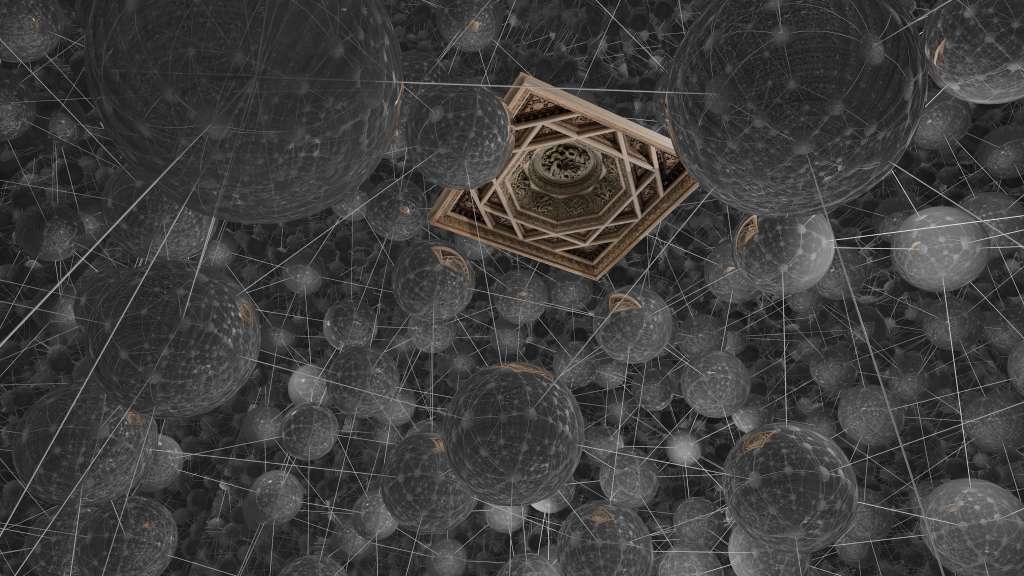
Dreams of a Coffered Ceiling: Reflections on Digital Curation

While curating Fragmented yet Connected: Paths to Wisdom at the Zhihua Temple, I kept returning to one question: what can digital reconstruction offer beyond visually recreating a lost historical state, especially when the cultural heritage in question has been dispersed or removed from the original context?
3D scanning can capture accurate dimensions and surface geometry. Digital models can be modified to reconstruct missing structures. Virtual environments can represent spaces that are no longer accessible in the physical world. Yet when a model is simply placed on a screen and rotated, digital reconstruction can easily become visual spectacle. But it does not necessarily help visitors understand the object’s significance or imagine how they might relate to it.
Digital objects differ from physical artifacts in important ways. They can be enlarged, dismantled, animated, moved, and adapted to different media and environments. These operations afford visitors to move between different scales, locations, and moments in an object’s history—experiences that would be difficult to create through the physical display. For me, however, the most important question was not simply what these technologies could do, but how a digital object might be situated in a web of relationships—with viewers, stories, and historical memories. Only through these relationships could digital reconstruction become meaningful experience.
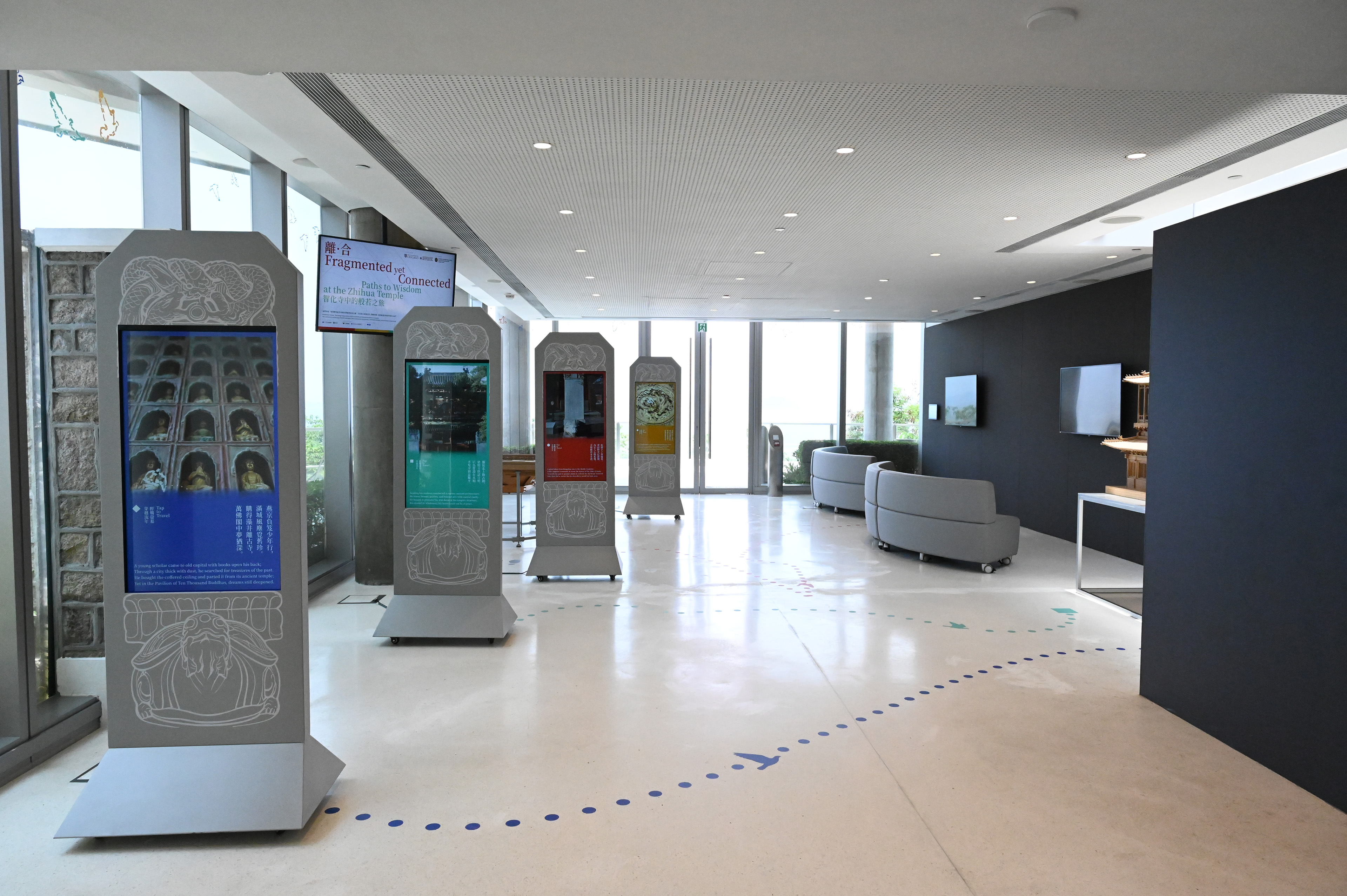
Fragmented yet Connected grew from this question. The exhibition centers on digital reconstructions of the Wanfo Pavilion and one of its coffered ceilings at Zhihua Temple, a Buddhist monastery founded in Beijing in 1444. In the early twentieth century, two coffered ceilings were removed from the temple. They were later acquired by the Philadelphia Museum of Art and the Nelson-Atkins Museum of Art in Kansas City.
Since 2019, the Dispersed Chinese Art Digitization Project (DCADP) team has 3D scanned and studied the ceilings in American museums, as well as the architectural spaces in Beijing from which they were removed. Researchers combined scan data with historical photographs, archival records, and on-site measurements to examine the dimensions, construction, and installation of individual components. They also examined how the ceilings once related to the timber framework, painted panels, sculptures, and other elements of the Wanfo Pavilion. For an example, see Digital Reconstruction of the Wanfo Pavilion.
Digital reconstruction cannot physically return the ceilings to the past. It can, however, create an environment in which dispersed objects, surviving architecture, and fragmented records can be compared and studied together. Elements now divided among Beijing, Kansas City, and Philadelphia could therefore be brought into relation once again.
In the exhibition, I did not want these models to be seen only as research outcomes. To give them a narrative role, I imagined a fictional world centered on the coffered ceiling itself. In this world, the violent moment of the ceiling’s removal awakens a special power within it. The ceiling begins to sense the obsessions, regrets, and aspirations of people connected to Zhihua Temple, transforming these emotions into dreams.
The ceiling dreams of four people from different historical periods: Wang Zhen (c. 1410–1449), the Ming-dynasty eunuch who founded Zhihua Temple; Shen Tingfang (1702–1772), a Qing official; Liu Dunzhen (1897–1968), a twentieth-century architectural historian; and Laurence Sickman (1907–1988), an American museum curator.
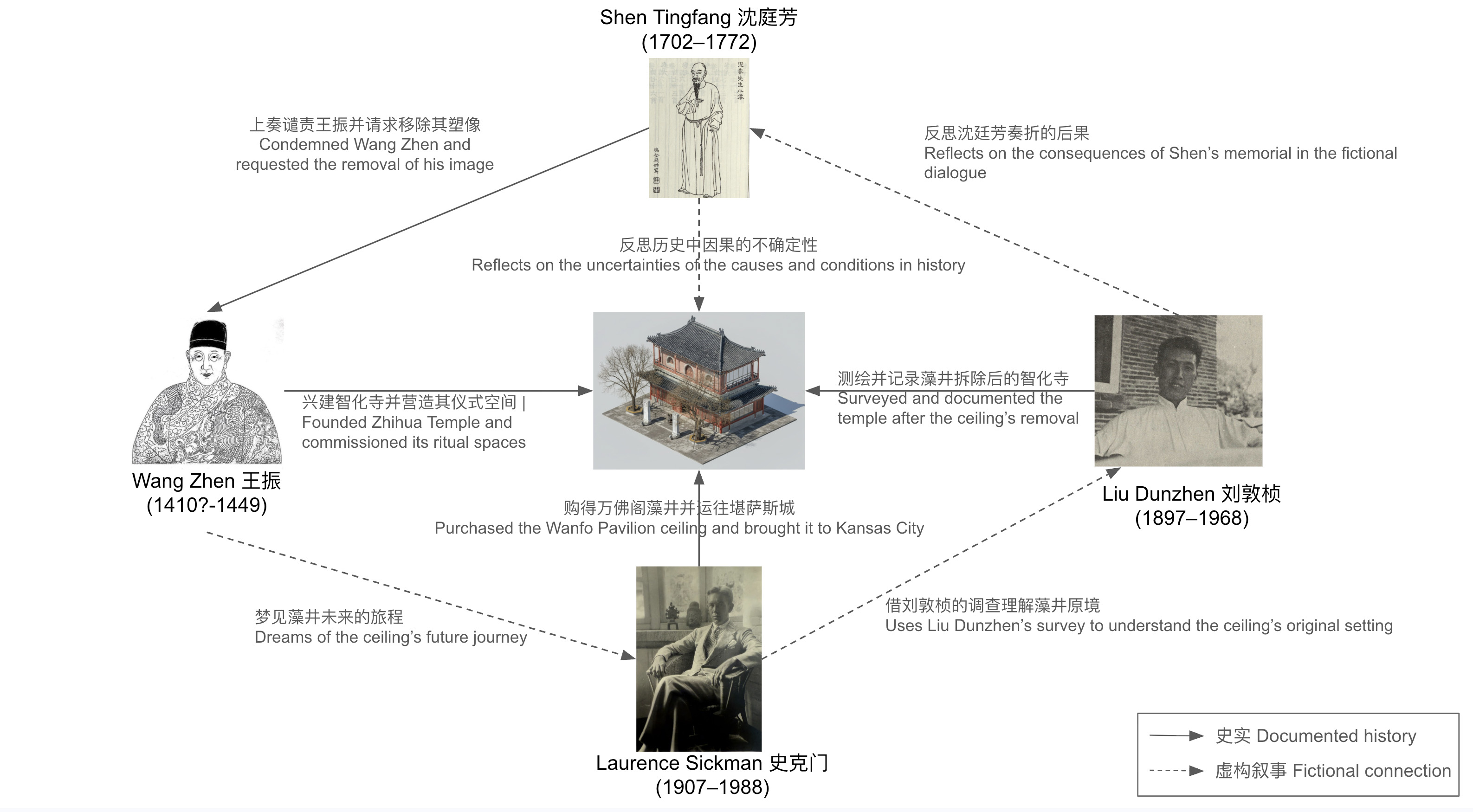
They never met one another, yet their actions successively shaped the temple’s story. Wang Zhen founded it. Shen Tingfang petitioned the Qing court to remove the temple’s commemorations of Wang Zhen. Liu Dunzhen surveyed and documented Zhihua Temple around the time the ceilings were removed. Sickman participated in the acquisition of the Wanfo Pavilion ceiling for an American museum. Their lives, separated by centuries, became part of an interconnected chain of causes and consequences. This idea of entangled lives and dreams nested across time was partly inspired by David Mitchell’s novel Cloud Atlas and its film adaptation:
“Our lives are not our own. From womb to tomb, we are bound to others, past and present, and by each crime and every kindness, we birth our future."
— David Mitchell, Cloud Atlas
Visitors enter these dreams through a series of interactive “narrative steles.” Each touchscreen kiosk invites them to converse with one of the four historical figures. Although the dialogues are fictional, their scripts are grounded in art-historical and provenance research. The stele format was also a deliberate choice. Historically, inscribed steles recorded people, events, and acts of merit, while shaping how later generations remembered them. The exhibition’s digital steles continue this work of commemoration and historical narration, but their texts are no longer fixed. They unfold through the visitor’s choices.

During each conversation, visitors can ask questions and respond to ethical dilemmas. Was a museum the safest place for a ceiling threatened by neglect and dispersal? Does preserving an object justify separating it from the building to which it belonged? How should later generations judge a historical figure whose patronage and political actions cannot easily be reconciled?

These questions do not have a single answer. Visitors may encounter the four steles chronologically or follow their own path through the gallery. Each dialogue refers to another character, allowing scattered clues to become gradually connected. This fragmented structure draws on a narrative technique commonly used in games: the full story is not given at once, but emerges through exploration, choice, and recollection.
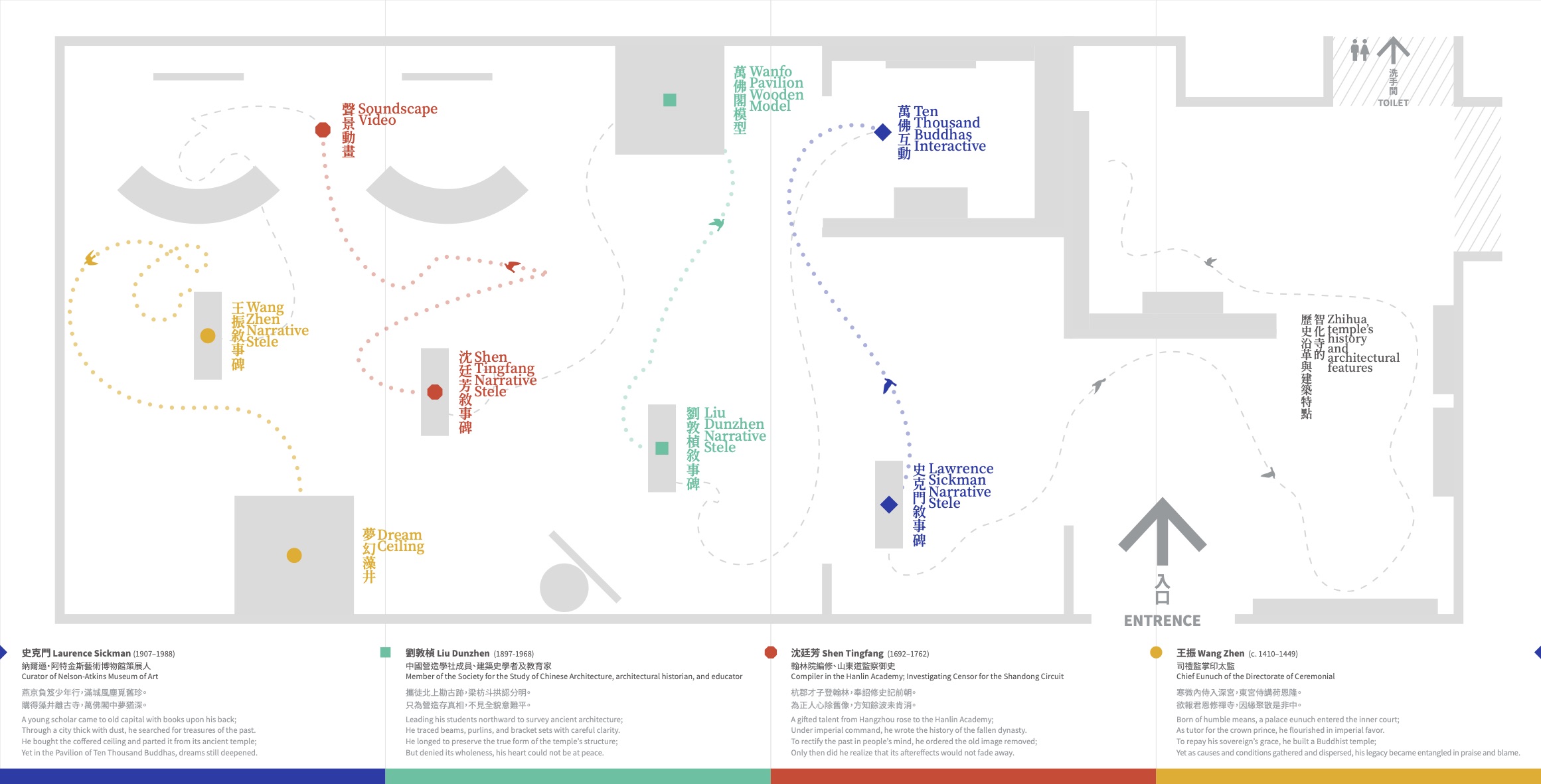
At the end of each dialogue, the narrative stele directs the visitor toward another installation, or “experiential node.” The character’s story therefore moves beyond the screen and into experiences shaped by sound, space, movement, and the visitor’s body. A real-time rendered video places the visitor’s own image within a reconstructed architectural environment, turning viewing into a journey through virtual space; a wooden model presents the reconstructed building as a physical structure that can be examined from different angles; an animated soundscape brings together poetry, sound, and memories of the temple; a mixed-reality experience allows visitors to examine the ceiling in real scale and move between its original setting in the Wanfo Pavilion and its present installation at the Nelson-Atkins Museum of Art.


These installations are not simply demonstrations of different technologies. Within the exhibition’s fictional world, each one responds to an unfulfilled desire of one the historical characters. The real-time rendered environment extends Laurence Sickman’s recurring dream of returning to the Wanfo Pavilion. The wooden model reflects Liu Dunzhen’s desire to document and preserve Chinese architecture. The animated soundscape evokes Shen Tingfang’s uncertainty between historical judgment and poetic reflection. The mixed-reality experience responds to Wang Zhen’s question: when later generations look at the ceiling, will they still understand the intentions embodied within it? Together, the narrative steles and experiential nodes form an interconnected story rather than a series of isolated digital installations. Visitors do not simply move from one technology to another. They participate and discover relationships between people, objects, places, and memories.
A conventional exhibition can juxtapose physical artifacts, but the digitally reconstructed ceiling can move between the Wanfo Pavilion, the museum gallery, and the dreamworld created by the exhibition. It can shift scale, reveal hidden relationships, and carry visitors from one setting to another, making changes in context part of the experience rather than simply describing them. As the ceiling moves, visitors can see how an object’s meaning changes with its surroundings and with the conditions under which it is viewed. The digitally reconstructed ceiling is therefore more than a 3D model—it becomes a narrator, a dreamer, and a medium connecting different times, places, and people.
Curating with digital objects should not replace encounters with physical artifacts. What it can offer is a different form of storytelling, one in which historical memories and diverse perspectives are brought into a shared, navigable experience. Rather than only receiving a fixed interpretation from a wall text, visitors can make choices, follow clues, move between viewpoints, and gradually assemble the story for themselves. In this way, the visitor becomes not simply an observer, but an active participant in the ever-growing story of an object.
Fragmented yet Connected: Paths to Wisdom at the Zhihua Temple is on display from June 5, 2026, to November 30, 2026, at The Hong Kong Jockey Club University of Chicago Academic Complex | The University of Chicago Francis and Rose Yuen Campus in Hong Kong. For more information visit Fragmented yet Connected: Paths to Wisdom at the Zhihua Temple.